
The U.S. Patent and Trademark Office has issued a Notice of Allowance to IlluminOss Medical Inc. for the company’s Photodynamic Bone Stabilization System (PBSS). The IlluminOss devices are limited by federal law to Investigational Use and are not approved for sale in the USA.
IlluminOss Receives Patent Office OK
1 min read Premium comments
Secondary
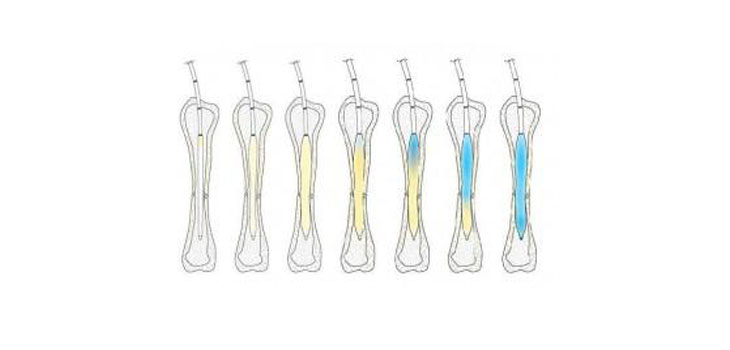
According to the company’s description, the minimally invasive PBSS stabilizes bone fractures or prevents impending fractures through its percutaneous, patient customized fracture fixation system. Using PBSS, clinicians insert an angioplasty-like balloon into the intramedullary canal across the fracture site, which is then filled with a liquid monomer. Once the positioning of the implant is verified, light is delivered through a proprietary fiber to cure the monomer for rapid stabilization of the bone. This results in a customized fit to each patient’s specific anatomy providing rotational and torsional stability to the fracture. PBSS can be implanted for stand-alone primary fixation or in combination with screws or plates.
“This strong and growing IP portfolio demonstrates that we are continuing to advance our innovative fracture fixation technologies as we expand our commercial efforts in Europe and work towards gaining regulatory approval in the United States, ” said Robert Rabiner, founder and chief technology officer of IlluminOss. “With the addition of these three new patents, we can confidently say that our IP portfolio covers the whole body.”
Dirk Kuyper, president and CEO of IlluminOss, said, “In addition to the robustness of our patent estate, IluminOss is gathering compelling clinical evidence that shows how our patient-customized approach to fracture repair has the potential to improve clinical outcomes.”
IlluminOss was founded in 2007 and is headquartered in East Providence, Rhode Island. The company currently markets its products under a CE Mark in Austria, Germany, Israel, Italy, the Netherlands, Spain, Switzerland and Turkey.
Author
React:
Discussion
This is a fascinating development. In my practice we've seen similar outcomes with the revised protocol. The key differentiator seems to be patient selection criteria. Has anyone else noticed the correlation with BMI thresholds?
Great point. I'd push back slightly on the conclusion, the sample size in the cited study is too small to draw population-level inferences. That said, the directional signal is compelling and worth a larger RCT.
We implemented a similar approach last year. Early results are promising but we're still gathering 12-month follow-up data. Happy to share our protocol if anyone is interested.
Join the conversation
Orthopedic professionals are discussing this. Sign in and upgrade to read every comment and add your voice.