
They are entering a new era at Hospital for Special Surgery (HSS) in New York. For 11 years, it has been the vision and drive of Thomas Sculco, M.D. that has led this outstanding facility to new heights. Now, says Dr. Sculco, it is time for a change. Enter Todd Albert, M.D. of the Rothman Institute.
HSS: Sculco Stepping Down, Albert Stepping Up
4 min read Premium comments
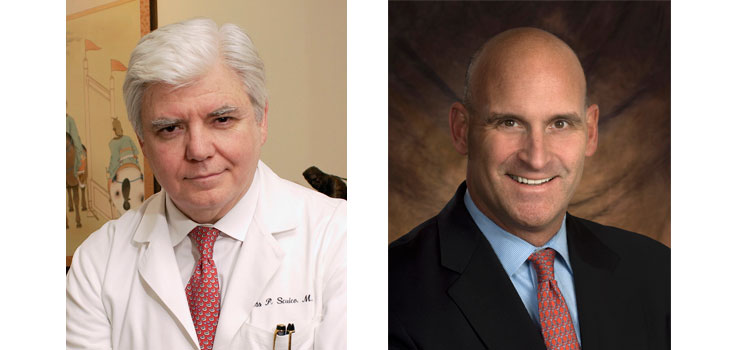
Dr. Sculco: “I believe in term limits.”
Dr. Sculco, who will be continuing his clinical practice at HSS and will become Surgeon-in-Chief Emeritus, performs 500-600 surgeries per year. He tells OTW, “When I accepted this position 11 years ago I had certain goals that I wanted to achieve and I have accomplished most of them. Now it’s time to move on; I believe in term limits. I find that if one is in a job too long it can lose some of its vitality. It’s good to move aside so that others may assume positions of leadership. At HSS the Surgeon-in-Chief is also Medical Director of the institution and with a busy surgical schedule and a great deal of international travel for teaching and research there is a finite period of time you can serve in this position.”
When asked about the accomplishments he cherishes, Dr. Sculco stated, “First of all, in the clinical area there was an access problem. There were many patients who wanted to come to HSS for care but they couldn’t access the institution. We needed to physically grow HSS and our faculty. We have doubled the clinical volume to 30, 000 operations per year and we have added 40 outstanding orthopedic faculty. Additionally, we now have 35 orthopedic operating rooms, we have created separate ambulatory surgery units for sports medicine and we did the same with hand and foot surgery. In keeping with the original vision of HSS when it was founded 150 years ago, we created a ‘pediatric orthopedic hospital’ within the walls of HSS to better care for the children who come to us for their treatment.”
“I am also proud of our accomplishments on the research side as we now have a vibrant clinician/scientist program where these individuals dedicate 40% of their time to research (we located a generous donor who provided $5 million to make that happen).”
“I have always believed that HSS should be a global leader in musculoskeletal care, therefore I created the International Society of Orthopaedic Centers (http://www.isocweb.org/) so that the largest and best orthopedic centers in the world could interact in a way that promotes optimal care, education and research. We now have 17 members around the globe, including the Rizzoli Orthopedic Institute in Bologna, Italy and Clínica Alemana de Santiago in Chile. We meet every 18 months to discuss many issues related to research funding, academic excellence, and how the field can survive economically in a challenging environment. We believe we should be setting the benchmarks for reduction in infection rates and other complications. At HSS we believe in sharing our clinical pathways to reduce cost but not sacrifice on quality and patients safety.”
“I am also proud of our residency and fellowship programs which have grown and provide outstanding orthopedic training to many who come here from throughout the world. I have been blessed to work with an amazing group of faculty and it has been a great privilege and honor to be their chief.”
Dr. Albert: “HSS is the Taj Mahal of orthopedics.”
Dr. Todd Albert is the Richard H. Rothman Professor and Chairman of Orthopaedics at Jefferson Medical College, and is Past President of The Cervical Spine Research Society. Dr. Albert, who has been at The Rothman Institute for 21 years, says that he is “incredibly excited” to join the “Taj Mahal of orthopedics.” He tells OTW, “This is going to be an extraordinary opportunity and I’m thrilled that I will be able to work so closely with Dr. Sculco and the incredible staff at HSS. One of my goals is to improve and unify surgery and services so that we can work toward even better population health. My vision is that we will be able to take care of the whole musculoskeletal bundle from start to finish, i.e., deliver and control the bundle of care for any kind of surgery. One way to do that is to create care pathways where everyone agrees what the map looks like…and adheres to it. Also, for a total joint, 50% of the cost of the bundle is after the patient leaves the hospital. So we will do our utmost to find a way to get control of that.”
Discussing his time at the Rothman Institute, Dr. Albert notes, “When I took over as chair we had a total of 20 physicians. Now we have 107; that is an increase of 500%. So I do understand growth and culture and I think I can help to work toward a unified culture at HSS. In our market we have done very well with the hub and spoke model. HSS is such a good brand, and I think my experience will help to extend that brand into the outlying communities and around the world. And because my mantra is ‘teamwork, ’ I will make every effort to include input from all my colleagues.”
Asked how he will know if he is succeeding a year from now, Dr. Albert said, “I’ll know things are going well if I can walk down the hall without a Kevlar vest!”
Orthopedics This Week wishes Drs. Sculco and Albert all the best in their new roles.
React:
Discussion
This is a fascinating development. In my practice we've seen similar outcomes with the revised protocol. The key differentiator seems to be patient selection criteria. Has anyone else noticed the correlation with BMI thresholds?
Great point. I'd push back slightly on the conclusion, the sample size in the cited study is too small to draw population-level inferences. That said, the directional signal is compelling and worth a larger RCT.
We implemented a similar approach last year. Early results are promising but we're still gathering 12-month follow-up data. Happy to share our protocol if anyone is interested.
Join the conversation
Orthopedic professionals are discussing this. Sign in and upgrade to read every comment and add your voice.