
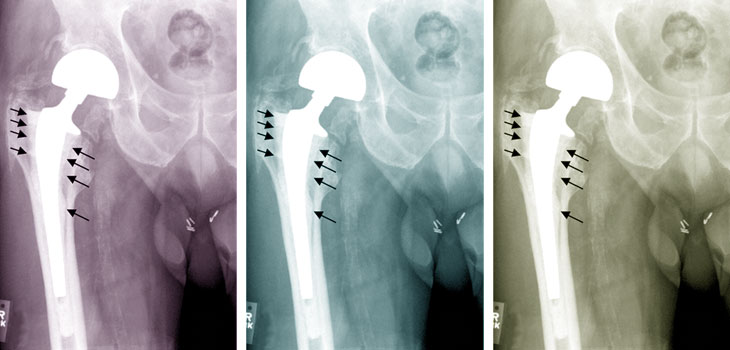
People who keep track of such things in the United Kingdom estimate that doctors perform 90, 000 hip replacements and 70, 000 knee implant surgeries annually. Of these, at least 10% will eventually develop osteolysis post surgery. Osteolysis is an inflammatory reaction to particles of the implants in the surrounding bones.
HRT Cuts Revisions after Joint Surgery
1 min read Premium comments
Secondary
When this happens, revision surgery is required. According to PR Web, a new study has discovered that hormone replacement therapy (HRT) can cut the risk of revision surgery in women by over 40%. A new led by the University of Oxford and published in the January Annals of the Rheumatic Diseases, analyzed data from almost 11, 000 women across the UK who had received knee or hip replacement for the first time between the years 1986 and 2006.
More than 21, 000 eligible women who met the criteria had not used HRT, while more than 3, 500 had done so for at least six months. This provided matched samples of 2, 700 HRT users and 8, 100 women who had not used HRT. Researchers tracked the risk of repeat surgery in both sets of women for three years. They found that those who had taken HRT regularly for six months or more after their surgery were 38% less likely to require repeat surgery than were those who had not done so.
Those who regularly took HRT for 12 months or more after their procedure were more than 50% less likely to need further surgery during the three year monitoring period. Interestingly, the findings showed that taking HRT before surgery made no difference to the risk of implant failure. The implication of the study was clear. Those who want a better rate of success should follow their surgery with a course of hormone replacement therapy.
Author
React:
Discussion
This is a fascinating development. In my practice we've seen similar outcomes with the revised protocol. The key differentiator seems to be patient selection criteria. Has anyone else noticed the correlation with BMI thresholds?
Great point. I'd push back slightly on the conclusion, the sample size in the cited study is too small to draw population-level inferences. That said, the directional signal is compelling and worth a larger RCT.
We implemented a similar approach last year. Early results are promising but we're still gathering 12-month follow-up data. Happy to share our protocol if anyone is interested.
Join the conversation
Orthopedic professionals are discussing this. Sign in and upgrade to read every comment and add your voice.