
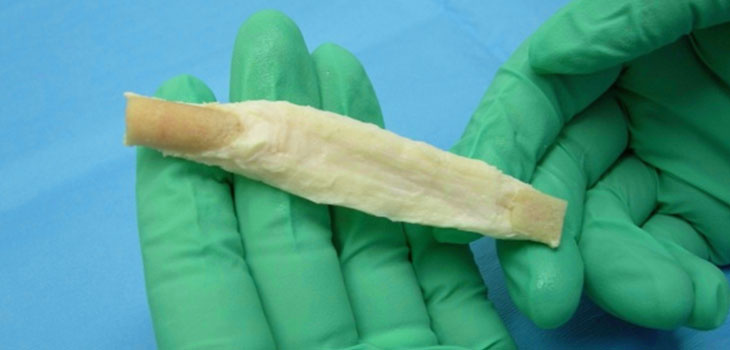
Aperion Biologics, Inc. has been granted CE Mark for the Z-Lig ACL Replacement Device. It is the first engineered biologic device for treatment of revision and multiligament anterior cruciate ligament (ACL) knee reconstruction to be granted a CE Mark or to be approved anywhere in the world.
CE Mark for Aperion Biologic’s ACL Reconstruction Device
2 min read Premium comments
Secondary
The approval for the off-the shelf biologic device was announced on April 22, 2014.
The company conducted a prospective, randomized, controlled clinical trial in Europe and South Africa that demonstrated biological acceptance of its bioengineered porcine tendons, re-establishment of knee stability, and remodeling over time into the patient’s own human ligament. U.S. clinical evaluation is pending final discussions with the FDA on its approved pivotal clinical study.
Kevin Stone, M.D., company founder, said the international trial and CE Mark approval, “independently confirm the successful results we saw in our U.S. pilot study which now has patients with Z-Lig devices 10 years after implantation. The advantage of an off-the-shelf, biologic device is it avoids the weakening of the patient by taking their own tissue.” (Dr. Stone was not a participant in the CE Mark trial.)
According to the company, over 600, 000 ACL reconstruction surgeries are performed around the globe annually, using either a patient’s own tissue (autografts) or cadaver tissue (allografts). “Prior attempts at use of animal tissue or synthetic grafts to meet the high demands of the knee have proven unsuccessful. The Z-Lig provides a revolutionary new option for patients around the world. Aperion’s device is designed to provide immediate stability and function to the knee while promoting gradual remodeling into human tissue over time, ” said the company announcement.
Compatible Animal Tissues
Aperion developed and patented a technique to make animal tissues compatible for human applications. The core platform technology utilizes a proprietary Z-Process, which removes the key antigens from animal tissues, followed by a conversion process that, according to the company, both stabilizes and sterilizes the tissue without affecting its biomechanical or biological properties. This creates functioning scaffolds capable of remodeling into healthy tissue. Aperion’s Z-Process is applicable to a variety of tissues used in orthopedic, cardiovascular, plastic, general and other surgical specialties. Currently, the device is not commercially approved for sale in the U.S. or other markets outside of the European Union.
Company Leadership
In addition to Dr. Stone, Aperion’s founder, the company is led by their CEO, Daniel Lee. Prior to joining Aperion in 2008, Lee was responsible for the Trurepair business unit at Smith & Nephew Endoscopy. Prior to Smith & Nephew, he was responsible for global marketing activities at OsteoBiologics, Inc. (OBI) which provided the only off-the-shelf bioabsorbable implant for articular cartilage repair in Europe. OBI was acquired by Smith & Nephew in 2006.
Author
React:
Discussion
This is a fascinating development. In my practice we've seen similar outcomes with the revised protocol. The key differentiator seems to be patient selection criteria. Has anyone else noticed the correlation with BMI thresholds?
Great point. I'd push back slightly on the conclusion, the sample size in the cited study is too small to draw population-level inferences. That said, the directional signal is compelling and worth a larger RCT.
We implemented a similar approach last year. Early results are promising but we're still gathering 12-month follow-up data. Happy to share our protocol if anyone is interested.
Join the conversation
Orthopedic professionals are discussing this. Sign in and upgrade to read every comment and add your voice.