
Attaching tendons to bones is one of the most common needs in orthopedic surgery. Companies fight hard to protect their proprietary methods for accomplishing such fixation.
Cayenne Medical Claims MedShape Violates Fixation Patent
2 min read Premium comments
Secondary
Cayenne Medical, Inc. claims MedShape, Inc. has violated one of their soft tissue reconstruction patents.
Infringement Alleged
The company filed suit in federal court in Arizona, alleging that MedShape’s ExoShape Femoral Soft Tissue Fastener infringed and continues to infringe Cayenne patents (United States Patent Nos. 7, 651, 528 and 8, 435, 294) that broadly cover Cayenne Medical’s novel AperFix System and methods for attaching soft material to bone, such as in an anterior cruciate ligament (ACL) reconstruction procedure.
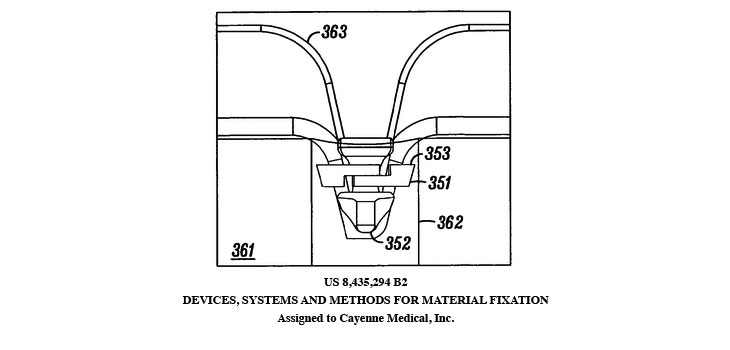
Cayenne’s ‘294 patent was filed in 2009 by Ken Montgomery, Sidney Fleishman, James Whayne, Kevin Ohashi, Nicanor Domingo, John Wright, Derek Harper and Heber Crockett.
Cayenne Medical’s Invention
The invention relates generally to devices, systems and methods for material fixation. More specifically, the invention relates to a technique that can be used to firmly hold a soft tissue or graft against bone tissue within a bone tunnel.
According to the abstract submitted to the patent office, the invention is an “exemplary surgical implant” with a modified bone anchor that is able to grasp the tendon and hold it firmly in a bone tunnel. “Once deployed, the anchor delivers lateral compression to the tendon, providing direct tendon to bone compression to facilitate healing. The anchor has different versions which allow it to be attached to the tendon prior to insertion into the bone tunnel, or be inserted between tendon arms when the surgical procedure dictates. The resulting tendon to bone compression allows for the firm fixation in a manner markedly simpler than traditional techniques. A modification of this anchor can also allow the anchor to grasp and hold suture. This variation facilitates the technique for knotless rotator cuff repair.”
Pros and Cons of Conventional Methods
The patent holders, in their application, noted that there are many conventional techniques used for the fixation of tendon to bone, each having some advantages. “The disadvantages of each such technique present a need in the art for a simple and universal technique to fixate tendon to bone such that the device is easy to use, the process is simple to follow, and the result is a firm and secure tendon to bone fixation with minimal negative effect on the tendon. Further, such device should be easy to manufacture, universally applied to different tendon to bone sites, and require minimal effort to understand and use in practice.”
“Elegant Simplicity”
They said their invention uses a device that is “easy to manufacture and use. In particular embodiments, the present invention is a modified anchor. The elegant simplicity of this invention eases the complexity of tenodesis procedures and its basic but effective design and use will make it readily adopted by the orthopedic community.”
David Springer, Cayenne Medical’s president and CEO said the company will use, “all reasonable measures to ensure that violators, such as MedShape, stop the infringement of our patented inventions.”
The company, privately held and headquartered in Scottsdale, Arizona, develops innovative soft tissue ligament and tendon repair and reconstruction products for the knee and shoulder.
Author
React:
Discussion
This is a fascinating development. In my practice we've seen similar outcomes with the revised protocol. The key differentiator seems to be patient selection criteria. Has anyone else noticed the correlation with BMI thresholds?
Great point. I'd push back slightly on the conclusion, the sample size in the cited study is too small to draw population-level inferences. That said, the directional signal is compelling and worth a larger RCT.
We implemented a similar approach last year. Early results are promising but we're still gathering 12-month follow-up data. Happy to share our protocol if anyone is interested.
Join the conversation
Orthopedic professionals are discussing this. Sign in and upgrade to read every comment and add your voice.