
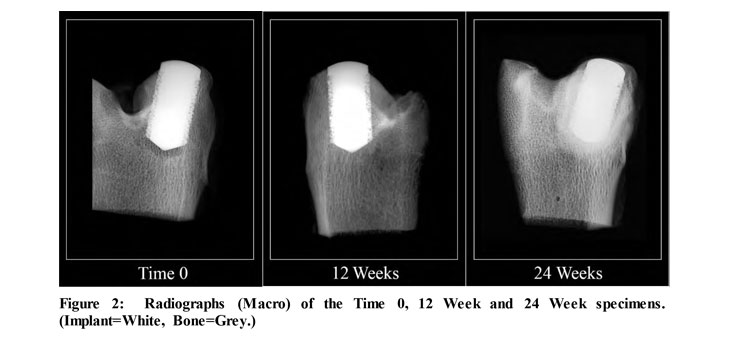
Renovis Surgical Technologies, Inc. has completed its Tesera Trabecular Titainum (T3) pilot animal study demonstrating the efficacy of this novel orthopedic implant. The study involved the implantation of the porous titanium device into a sheep model with successful primary fixation and secondary ingrowth. The study, which involved 12 sheep, was designed to quantify and establish a time line of the rate of bony ingrowth into a porous titanium device placed into the medial femoral condyle of a sheep.
Renovis: Porous Titanium a “Go” in Sheep
1 min read Premium comments
Secondary
The sheep received flourochrome double labeling injections 16 days and 5 days prior to euthanasia. Three sheep received plugs in the contralateral control limbs immediately following sacrifice to provide time zero data.
The researchers found no adverse cellular reaction within the porous coating of the implant. Analysis showed bony attachment and bone ingrowth in the porous coating at the 12 week time point with that number nearly doubling by 24 weeks. Implant histology revealed that the bone was viable and light microscopy showed that there were no adverse effects due to the titanium porous coating. The team found continuing bone formation and remodeling bone with osteoblast activity at both the 12 and 24 week time points. The experimental results from this translational study support that an implant system, appropriately placed in close approximation to the prepared or resected host bone surface should achieve excellent skeletal attachment.
Payam Moazzaz, M.D., an orthopedic surgeon with Orthopaedic Specialists of North County in California, has used the PEEK version of the first product that will feature this technology. He told OTW, “Renovis Surgical’s T3 structure is an intriguing and very promising new development for spinal and orthopedic implants. Its powerful bone ingrowth and ongrowth potential may soon revolutionize the manner in which spine surgeons achieve a stable fusion construct.”
Author
React:
Discussion
This is a fascinating development. In my practice we've seen similar outcomes with the revised protocol. The key differentiator seems to be patient selection criteria. Has anyone else noticed the correlation with BMI thresholds?
Great point. I'd push back slightly on the conclusion, the sample size in the cited study is too small to draw population-level inferences. That said, the directional signal is compelling and worth a larger RCT.
We implemented a similar approach last year. Early results are promising but we're still gathering 12-month follow-up data. Happy to share our protocol if anyone is interested.
Join the conversation
Orthopedic professionals are discussing this. Sign in and upgrade to read every comment and add your voice.