
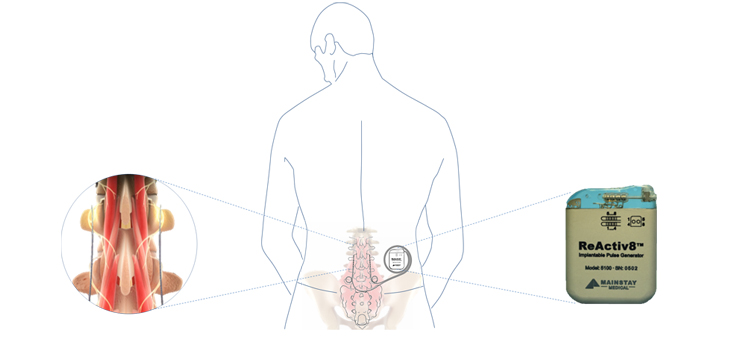
A clinical trial of a device to treat chronic low back pain (CLBP) is set to begin in three clinical sites in Australia. Called the ReActiv8, the neurostimulation device is made by Mainstay Medical of Swords, County Dublin, Ireland. The purpose of the clinical trial is to investigate ReActiv8 as a treatment for adults with debilitating chronic low back pain for whom surgery is not indicated.
New Device Attacks Lower Back Pain
2 min read Premium comments
Secondary
Company officials claim that one of the root causes of CLBP is impaired control by the nervous system of the muscles that stabilize the spine in the lower back. An unstable spine can lead to back pain. ReActiv8 is designed to electrically stimulate the nerves responsible for contracting these muscles and thereby help to restore muscle control and improve spine stability.
“Our novel approach of electrical stimulation to help restore the muscle control system is based on published scientific research, and the performance of the therapy was demonstrated in the recently completed European Feasibility Study.” said Peter Crosby, CEO of Mainstay Medical. “The energy and experience of the Mainstay Medical team has enabled us to complete the development of our therapy-specific device and obtain approval to start the ReActiv8 clinical trial within a year after the Feasibility Study results.”
Results from Mainstay Medical’s European Feasibility Study showed a statistically significant and clinically important improvement in key outcome measures, including reduction in pain and disability from CLBP and an improved quality of life.
Crosby notes that people with debilitating CLBP usually have a greatly reduced quality of life and score significantly higher on scales for disability, depression, anxiety and sleep disorders. Their pain and disability can persist despite the best available medical treatments. Most of these people have no indications for spine surgery. Their ability to work or be productive is seriously affected by the condition and the resulting days lost from work, disability benefits and health resource utilization put a significant burden on economies.
“Back pain specialists from all over the world have told us that they need a new approach to help the large group of people with CLBP who are stranded without a viable alternative. We believe that ReActiv8 can play an important role in helping these people, ” Crosby said.
Author
React:
Discussion
This is a fascinating development. In my practice we've seen similar outcomes with the revised protocol. The key differentiator seems to be patient selection criteria. Has anyone else noticed the correlation with BMI thresholds?
Great point. I'd push back slightly on the conclusion, the sample size in the cited study is too small to draw population-level inferences. That said, the directional signal is compelling and worth a larger RCT.
We implemented a similar approach last year. Early results are promising but we're still gathering 12-month follow-up data. Happy to share our protocol if anyone is interested.
Join the conversation
Orthopedic professionals are discussing this. Sign in and upgrade to read every comment and add your voice.