
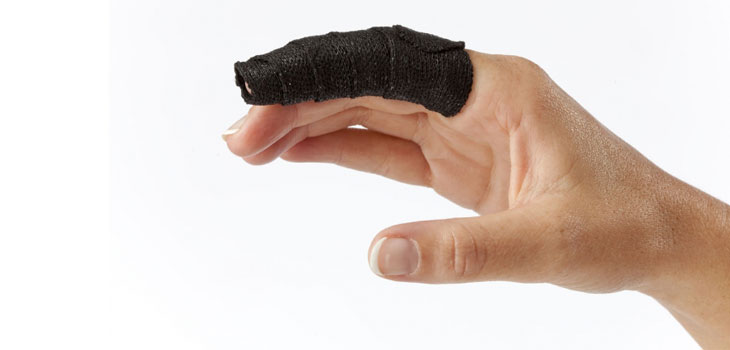
Anyone who has struggled to bandage a wounded finger or thumb may find Orfit Industries’ new product, Orficast, of interest. Orficast is a new moldable thermoplastic for finger splints that, according to the company’s description, is stretchable and self-adhesive. It is knitted from thermoplastic fibers and comes in two widths—3 centimeters for finger and toe injuries, and 6 centimeters for thumb injuries.
Moldable Thermoplastic Finger Splint
1 min read Premium comments
Secondary
Company officials say that Orficast can be softened in a matter of seconds in hot water and then molded directly onto the patient while the knitted structure allows for skin ventilation. The material can also be cut to length and shape with regular scissors and applied directly on the skin without the need for protective gloves or lotion.
Steven Cuypers, CEO of Orfit Industries, says that since Orficast is self-adhesive it can be easily stretched in two directions around a joint to create a perfectly fitting circular splint or cast. Thanks to its 100% thermoplastic memory, the material can be unwrapped, re-heated and the splint can be re-shaped and re-applied. The same material can be reused throughout treatment for serial splinting or casting. “Orficast offers quick and easy, yet rigid customized immobilization without the need to use gloves or a casting saw, as is the case with other synthetic casting materials, ” Cuypers said.
Author
React:
Discussion
This is a fascinating development. In my practice we've seen similar outcomes with the revised protocol. The key differentiator seems to be patient selection criteria. Has anyone else noticed the correlation with BMI thresholds?
Great point. I'd push back slightly on the conclusion, the sample size in the cited study is too small to draw population-level inferences. That said, the directional signal is compelling and worth a larger RCT.
We implemented a similar approach last year. Early results are promising but we're still gathering 12-month follow-up data. Happy to share our protocol if anyone is interested.
Join the conversation
Orthopedic professionals are discussing this. Sign in and upgrade to read every comment and add your voice.