
“Resurfacing is more invasive, has worse outcomes, and produces metal ions and pseudotumors, ” says Michael Dunbar. Edwin Su differs in opinion, saying, “Surface replacement is better because you get better bone preservation, greater stability, and a higher activity level.”
Dunbar, Su Debate Surface Replacement Arthroplasty
7 min read Premium comments
Great Debates
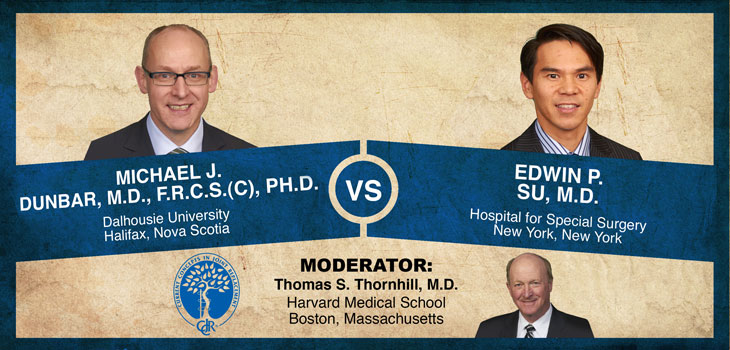
This week’s Orthopaedic Crossfire® debate is “MOM Surface Replacement Arthroplasty: Throw That Baby Out.” For the proposition is Michael J. Dunbar, M.D., F.R.C.S.(C), Ph.D. from Dalhousie University; against the proposition is Edwin P. Su, M.D. from Hospital for Special Surgery. Moderating is Thomas S. Thornhill, M.D. from Harvard Medical School in Boston.
Dr. Dunbar: “The metaphorical baby of resurfacing arthroplasty was dropped like a bomb by the stork into the UK and Australia from 2004-6 where staggering numbers of patients under 55 received such implants (46% in the UK and 29% in Australia).”
“The best argument Ed will have is that resurfacing works best in the young male. The first reason proposed is ‘because the metal bearing provides an advantage to survivorship.’ We can see from multiple hip replacements and multiple studies that when you compare to a total hip replacement all comers—a bit unfair—that resurfacing doesn’t fare as well. But we also know from this data that we’ve stopped doing this surgery in women because they fare far worse than men. This has been accepted to the point where when we look at risk factors, it’s now associated with older patients, smaller femoral head size, patients with developmental dysplasia, and certain implant designs.”
“The experience of the UK is discouraging; the survivorship curves are worse than they are in Australia. Associated with metal-metal bearings—and particularly resurfacing—has been the generation of metal ions and the subsequent problems. In a Canadian multicenter study (Kim et al., 2011) we found that metal ions degenerated, but remained persistently elevated after two years. The concept at the time was that the ions would be generated with the wear-in period, they would then dissipate and it would be OK. That wasn’t our experience. We’ve had excellent groups around the world—in particular Oxford University—reporting on pseudotumors associated with metal ions. They had the same experience in the Netherlands (Bisschop et al., 2013) where they reported on large numbers of pseudotumors being generated at five years with metal-metal implants.”
“With the generation of metal ions in these young patients you end up in a new paradox because you have troubles that you’ve never had to deal with as an orthopedic surgeon. For example, we now have to deal with pain with metal-metal, and therefore we have to study metal ions. We don’t know if we should get serum or urine, or if cobalt/chromium is the one to look at, and we don’t know how precise a single estimate is. If they are elevated we need to move to an MRI and they’re difficult to interpret and perform. And we may need to revise for pseudotumor or high ion levels. Why would you want these headaches?”
“Resurfacing is proposed for the young male also because it’s perceived to be a less invasive procedure than THA. Nonsense. It’s maximally invasive because these are young, strong males with big muscles. And because you have to leave the head it’s difficult to get to the acetabulum. This exposure may result in odd things, such as avascularity to the femoral neck…which may result in fracturing. And it also may lead to femoral neck narrowing.”
“Another argument is that we should resurface in young males because if it fails we’ve left the femoral canal virginal and we can then put a total hip in these patients with no problem…but that’s not the case. Let’s look at the data from a series of 397 cases from the Australian registry that failed and went on to total joint replacement. When they were placed back on the survivorship curves they were not on the same curve as if they had had a primary total hip replacement; they had a much worse survivorship curve.”
“Another argument is that we should resurface in males because it’s an intact femoral head and it results in better function. A Canadian randomized trial that won the John Charnley Award (Lavigne, 2010) looked at resurfacing versus large head metal-metal. They did gait analysis, etc., and found no difference in the outcome in terms of advantage. Yes, you have a larger head, but you also have a larger neck intact…so there is sometimes an advantage to having a THA [total hip arthroplasty] such as better ROM [range of motion] and functional outcome.”
Dr. Su: “We’ve heard about the negative consequences of metal-metal (MOM) total hip replacements; metal-metal resurfacing is not the same thing. The types of problems are different with resurfacing versus a large diameter MOM total hip replacement. I think there is still a role for hip resurfacing in the treatment of hip arthritis.”
“We all know that hip replacement is one of the most successful operations that we have to improve mobility and relieve pain. But it’s not perfect, and there is a large body of experience with a generation of hip replacements that with time there will be wear and osteolysis. If you look at the Swedish registry, specifically at the results in younger patients (under 60), we see that the survival rate of a total hip replacement is poor after the tenth year. And there is about a 30-40% revision rate nearing 20 years.”
“Dislocation is also a problem with total hip replacement, and dislocation as a reason for revision is increasing. I think that’s because patients are more active, and we are putting these in younger and younger patients. So the challenge is to perform a hip arthroplasty in young active patients, the group that poses the greatest challenge to implant longevity; their high activity level may lead to earlier need for revision.”
“I think there are several benefits to hip resurfacing. It preserves bone and leads to greater stability. It gives better reproduction of the natural anatomy of the hip in terms of length, offset, and anteversion. It also loads the bone more physiologically and, I think, gives a greater activity level. It’s indisputable that a hip resurfacing preserves femoral bone. We’ve done a cadaver study where we looked at the amount of bone we saved, and it was about 300% of bone saving on the femoral side with no additional bone removed from the acetabular side. It also provides a more stable joint.”
“Regarding the more physiologic loading of the bone, as opposed to a hip replacement, which receives load from the top, transmits it through the stem into hoop stresses. A hip resurfacing receives load from the top and transmits it through the femoral neck…as your own hip would. My point is, ‘What will happen with the continued loading of the implant?’ Loading in tension may cause femoral stem fatigue fractures.”
“There is also better restoration of normal hip mechanics. You will see patients with high offset hips, and there is no total hip replacement—whether you template it or use a different varus extended neck offset stem—that can reproduce that high offset. There is 2012 data by Professor Haddad showing that there is a higher activity level with resurfacing. In that 10 year follow-up of a prospective, randomized study on THR [total hip replacement] versus hip resurfacing, the latter group had higher activity scores. And a survey from Dr. Barrack also found that resurfacing patients felt they had fewer limitations than THR patients.”
“As Michael said, hip replacements in certain subgroups are performing well in national joint registries. If you look at the 10 year revision rate of resurfacing in males in the Australian registry, it is about 6%; in a THR in that same group it’s roughly 8%.”
Moderator Thornhill: “Ed, in following your MOM resurfacing patients, when do you measure levels in them, when do you get an ultrasound and/or MRI?”
Dr. Su: “I routinely measure metal levels at one, three, five years. There isn’t conclusive data that we should be doing it for everyone. Anyone symptomatic will get some sort of cross sectional imaging. The levels at which I get worried will differ depending on the amount of symptoms.”
Moderator Thornhill: “And Michael, you just say, ‘Why worry about that? Just don’t do them.’”
Dr. Dunbar: “But I end up seeing patients who have them in. We don’t truly know the answers as far as what specimen should be taken and when. So I don’t like being in a situation where there are elements I don’t understand. THA is arguably one of the best operations out there and we’ve strangled it by trying to be innovative and potentially making errors along the way. I don’t know when to get the ion levels. If they’re symptomatic, I will…and if those are elevated I will get cross sectional imaging. Then I have difficulty interpreting the cross sectional imaging.”
Moderator Thornhill: “Ed, in the past you’ve talked about revisiting the concept of a metal-poly now that we have better polyethylene. Are you doing this?”
Dr. Su: “I think it’s being talked about. We all realize that hip resurfacing can be an attractive concept to save the bone, but the metals are its Achilles’ heel. We’d love to get rid of it; with the highly cross linked poly it’s a possibility, but we must be able to show good poly strength…and that it’s not going to have a fatigue fracture in the dimensions that we need to make it.”
Dr. Thornhill: “Michael, your thoughts on that?”
Dr. Dunbar: “Perhaps we’re chasing our tail again. There is promise there, and there is probably a middle ground for some patients. But we need to say, ‘Enough of the chaotic innovation. We must go slowly and methodically. And we must report problems immediately…before we have a new bearing in thousands of patients.”
Moderator Thornhill: “Thank you, gentlemen.”
Please visit www.CCJR.com to register for the 2014 CCJR Spring Meeting, May 18 – 21 in Las Vegas, Nevada.
Author
React:
Discussion
This is a fascinating development. In my practice we've seen similar outcomes with the revised protocol. The key differentiator seems to be patient selection criteria. Has anyone else noticed the correlation with BMI thresholds?
Great point. I'd push back slightly on the conclusion, the sample size in the cited study is too small to draw population-level inferences. That said, the directional signal is compelling and worth a larger RCT.
We implemented a similar approach last year. Early results are promising but we're still gathering 12-month follow-up data. Happy to share our protocol if anyone is interested.
Join the conversation
Orthopedic professionals are discussing this. Sign in and upgrade to read every comment and add your voice.