
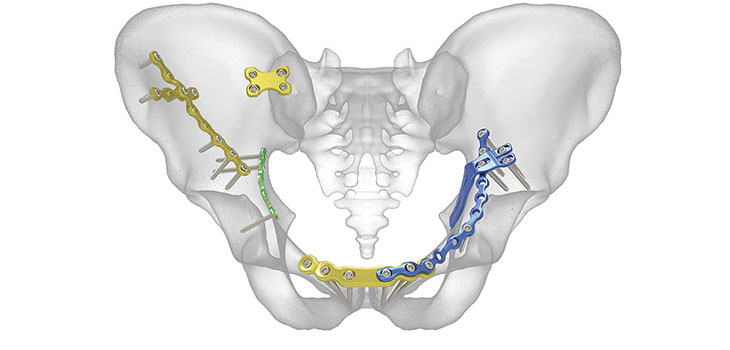
Acumed is venturing into a new market—orthopedic implants and instrumentation for the surgical repair of fractures and joint disruptions of the pelvis. Their new Pelvic Plating System includes plates, screws and instrumentation designed to provide fixation for fractures, fusions, and osteotomies of the acetabulum, sacrum, ilium, and pelvic ring as well as treatment of sacroiliac joint dislocations and symphysis pubis disruptions. Acumed’s pelvic fracture system was developed in conjunction with leading trauma surgeons and is Acumed’s first step in its plans to expand its presence in trauma.
Acumed Launches Pelvic Plating System
1 min read Premium comments
Secondary
The system features both strategically pre-contoured and un-contoured plates, pre-contoured in places where it may save time and add secure fixation, and un-contoured in places to allow for buttressing of fractures or varying patient anatomy. In addition, Acumed’s new system allows for the option to bend any of the pelvic plates, utilizing instrumentation provided within the system.
Further, enhancements to traditional pelvic instrumentation (which include various pliers, cutters, clamps and drills) are incorporated with the intention to ease surgical techniques and reduce time in surgery to benefit both surgeon and patient.
“Acumed is focused on expanding our trauma presence in areas where we feel we can leverage engineering excellence and innovation to provide new solutions, ” said Rich Rice, Acumed vice president of extremities, trauma and biologics, in the March 21, 2014 news release.
“We identified pelvic fractures as an indication where very little innovation has occurred in the last ten years, ” he adds. “Moreover, with the aging population in developed countries, we feel the incidence rate of pelvic fractures per year will increase and there will be a need for better solutions than are on the market today.”
Rice told OTW, “During the development process we found that completely anatomically contoured plates are not always the most beneficial. Allowing the surgeon to make final contours where necessary is important for proper fixation in most pelvic cases. Also based on current and minimally invasive techniques, we identified a need to improve instrumentation for reduction and provisional fixation.”
Author
React:
Discussion
This is a fascinating development. In my practice we've seen similar outcomes with the revised protocol. The key differentiator seems to be patient selection criteria. Has anyone else noticed the correlation with BMI thresholds?
Great point. I'd push back slightly on the conclusion, the sample size in the cited study is too small to draw population-level inferences. That said, the directional signal is compelling and worth a larger RCT.
We implemented a similar approach last year. Early results are promising but we're still gathering 12-month follow-up data. Happy to share our protocol if anyone is interested.
Join the conversation
Orthopedic professionals are discussing this. Sign in and upgrade to read every comment and add your voice.