
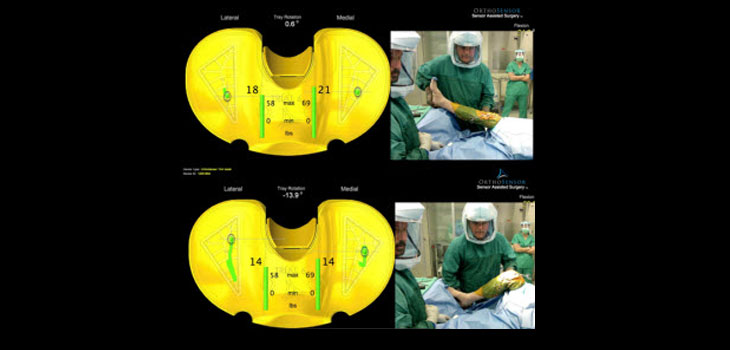
A new device, made by OrthoSensor Inc. and called the VERASENSE, will do away with guesswork when a surgeon is quantifying soft tissue balance during a total knee arthroplasty (TKA), according to company officials. As described by James Snodgrass, writing for European Plastics News, the VERASENSE is a sterile, disposable plastic sensor that is placed between both plates of the replacement joint. The device uses sensor and accelerometer technologies to sense dynamic loads, the contact point of the femur through a full range of motion and verifies the alignment of limbs.
VERASENSE Removes TKA Guesswork
2 min read Premium comments
Secondary
Snodgrass quotes Peter Walker, Ph.D. of New York University’s Langone Medical Center, who said, “At the moment the surgeon relies on skill, experience and a lot of instrumentation to shape the bones so that they will accept the components very accurately. But one of the more difficult parts of the surgery is getting the knee to move very, very smoothly after the components are placed. It is a very, very difficult job because every patient is different.
“You are dealing with structures that have been arthritic, the joint surfaces have been arthritic, and you have to put the components in a very perfect alignment to restore what the knee was like when the knee was healthy. One of the things that can happen is a restricted range of motion. Everybody wants to get at least 120° if possible, ” he said.
The device’s measurement of inter-compartmental loads and centre-of-load data provide a reference to determine the optimum placement of the tibia and femur and optimum balance of ligaments through a full range of motion. Thus, according to the company, the doctor can make evidence-based decisions regarding component position, soft tissue releases and limb alignment rather than relying on experience.
“The idea is to get the forces exactly equal on both sides of the knee, so the knee is perfectly balanced, ” said Walker, “so when you use it later on, in function, it will move very smoothly and be very stable.”
The disposable device connects wirelessly to a transceiver and information is sent, via the transceiver, to control software on the surgeon’s PC.
Because of its direct contact with exposed tissue, biocompatibility of the device was crucial. The case is injection molded in four sizes from Bayer MaterialScience’s Makrolon Rx1851 polycarbonate. According to Snodgrass, the VERASENSE received U.S. Food and Drug Administration clearance for limb alignment in June 2013 and received European CE approval in October 2013. The company has now launched the product in the European market.
“We’re pleased to have successfully achieved CE Mark for our VERASENSE technology, ” said Jay Pierce, OrthoSensor president and CEO. “This enables us to provide OrthoSensor’s innovative technology to orthopaedic surgeons and patients in markets outside the US and creates significant growth opportunities for our business.”
Author
React:
Discussion
This is a fascinating development. In my practice we've seen similar outcomes with the revised protocol. The key differentiator seems to be patient selection criteria. Has anyone else noticed the correlation with BMI thresholds?
Great point. I'd push back slightly on the conclusion, the sample size in the cited study is too small to draw population-level inferences. That said, the directional signal is compelling and worth a larger RCT.
We implemented a similar approach last year. Early results are promising but we're still gathering 12-month follow-up data. Happy to share our protocol if anyone is interested.
Join the conversation
Orthopedic professionals are discussing this. Sign in and upgrade to read every comment and add your voice.