
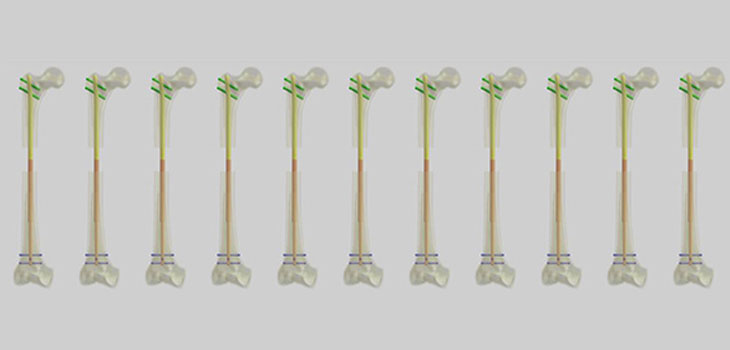
The FDA has granted “marketing clearance” to Ellipse Technologies, Inc.’s Intramedullary Limb Lengthening System for the lengthening of the femur and tibia. Called the Precice 2 system, it provides for a noninvasive adjustment of the implant that, the company claims, is unavailable with other treatment options. The Precice system was originally cleared for use in the U.S. in 2011.
Limb Lengthening System Gets Marketing Clearance
1 min read Premium comments
Secondary
The company reports that its Precice 2 devices have been used by more than 100 surgeons in over 700 procedures in 12 countries. The firm’s release states that the “system introduces a non-modular intramedullary design to simplify its implantation and provides increased nail length and distraction range options to better optimize treatment options. This system also includes a new smaller diameter (8.5 mm) nail, which will address a segment of patients whose anatomy was too small for the original, larger” nail devices.
“The introduction of the Precice 2 system complements the early success of the Precice device with improved efficiency in the OR and the larger range of patients with limb length inequality who can now be treated, ” said Ed Roschak, president and CEO of Ellipse.
Surgeons Shawn C. Standard, M.D., Head of Pediatric Orthopedics at the International Center for Limb Lengthening at Sinai Hospital in Baltimore, and Dror Paley, M.D., Director of the Paley Advanced Limb Lengthening Institute at St. Mary’s Medical Center in West Palm Beach, were the first surgeons in the U.S. to use the Precice 2 system.
“Previously, treatment options for patients with limb length inequality were very limited. The Precice system has dramatically impacted my practice over the last two years, and, with Precice 2, I expect even better results for my patients.” said Standard.
Paley added, “The Precice 2 system makes a great device even better and allows me to treat a wider spectrum of patients than before.”
Author
React:
Discussion
This is a fascinating development. In my practice we've seen similar outcomes with the revised protocol. The key differentiator seems to be patient selection criteria. Has anyone else noticed the correlation with BMI thresholds?
Great point. I'd push back slightly on the conclusion, the sample size in the cited study is too small to draw population-level inferences. That said, the directional signal is compelling and worth a larger RCT.
We implemented a similar approach last year. Early results are promising but we're still gathering 12-month follow-up data. Happy to share our protocol if anyone is interested.
Join the conversation
Orthopedic professionals are discussing this. Sign in and upgrade to read every comment and add your voice.