
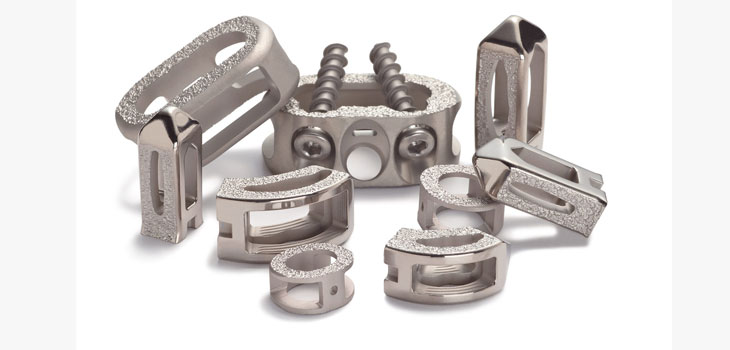
Titan Spine is celebrating the awarding of five new patents from the U.S. Patent and Trademark Office. These patents relate to the unique design of the company’s Endoskeleton line of interbody devices as well as various aspects of composite devices featuring a combination of metal and polymer materials, such as polyetheretherketone (PEEK). Titan Spine now has over 40 patents in their portfolio and currently under review.
Titan Spine: Five New Patents
1 min read Premium comments
Secondary
One aspect of the Endoskeleton design that is covered by one of these new patents is the presence of transverse and anterior/posterior windows optimized for strength, visualization of bone graft integration and loading of bone graft for improved fusion.
Kevin Gemas, president of Titan Spine, told OTW, “The strength of titanium, unlike PEEK, allows us to create transverse windows on our devices that allow for multi-directional bone growth and an increased potential for a robust fusion. We are pleased to further protect this key feature of our implant design.”
Chad Patterson, director of Product Development and Operations for Titan Spine, said in the January 21 news release, “All of our current and pending patents will continue to bolster our position among the ever expanding number of companies that are beginning to realize the importance of surface technology. Our goal is to aid in faster patient recovery through advanced surface technology, implant design, and surgical technique methods.”
Titan Spine’s proprietary surface technology has been shown to promote a superior osteogenic environment when compared to smooth titanium or PEEK. This surface technology, which contains unique topographies at the macro, micro, and sub-micron levels, is featured on the company’s line of Endoskeleton interbody devices for the cervical and lumbar spine.
Author
React:
Discussion
This is a fascinating development. In my practice we've seen similar outcomes with the revised protocol. The key differentiator seems to be patient selection criteria. Has anyone else noticed the correlation with BMI thresholds?
Great point. I'd push back slightly on the conclusion, the sample size in the cited study is too small to draw population-level inferences. That said, the directional signal is compelling and worth a larger RCT.
We implemented a similar approach last year. Early results are promising but we're still gathering 12-month follow-up data. Happy to share our protocol if anyone is interested.
Join the conversation
Orthopedic professionals are discussing this. Sign in and upgrade to read every comment and add your voice.