
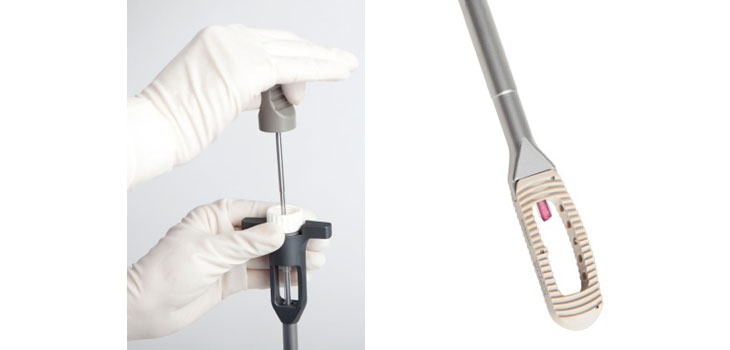
Pinnacle Spine Group, LLC is announcing that an independent study has found that its InFill Graft Delivery System performed better than traditional prepacking methods. The study was designed to evaluate the efficacy of a novel graft filling technique for maximizing interbody space and implant filling and optimizing endplate surface contact with the graft.
Study: Pinnacle’s InFill Trumps Traditional Methods
1 min read Premium comments
Secondary
The study, conducted by Burak M. Ozgur M.D., FAANS and Erin Gleckman PA-C, of Newport Beach, California, demonstrated a successful increase in interbody space and cage filling, with greatly enhanced endplate surface contact. Volumetric analysis 3-D CT scanning confirmed that up to 94% more graft material can be placed and contained between the vertebrae, including endplate surface contour filling and contact, when compared to traditional prepacking methods
Zach Sowell, VP of Marketing told OTW, “We are very pleased with the outcome of the study. The results prove that a surgeon can achieve greater contact between the graft material and the vertebral bodies when using the InFill Graft Delivery System over the traditional method of pre-packing the implant.”
The InFill Graft Delivery System was designed around the concept of placing autogenous graft material into the graft chamber of the implant in situ. It can be used to bulk up a pre-packed implant, or for a complete fill of the implant to maximize contact with the vertebral endplates.
React:
Discussion
This is a fascinating development. In my practice we've seen similar outcomes with the revised protocol. The key differentiator seems to be patient selection criteria. Has anyone else noticed the correlation with BMI thresholds?
Great point. I'd push back slightly on the conclusion, the sample size in the cited study is too small to draw population-level inferences. That said, the directional signal is compelling and worth a larger RCT.
We implemented a similar approach last year. Early results are promising but we're still gathering 12-month follow-up data. Happy to share our protocol if anyone is interested.
Join the conversation
Orthopedic professionals are discussing this. Sign in and upgrade to read every comment and add your voice.