
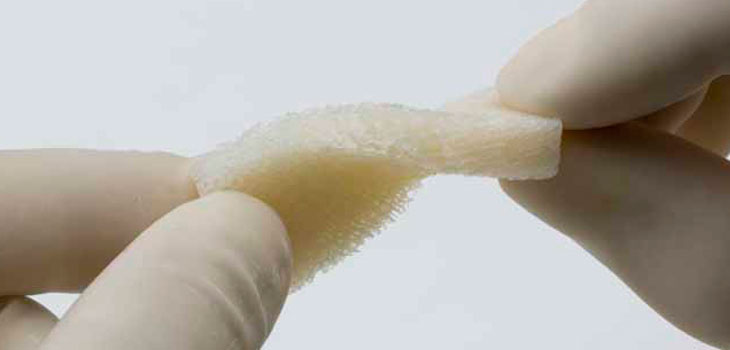
DePuy Synthes Spine and DePuy Synthes Biomaterials have collaborated to produce a hydrated, pliable and totally demineralized cancellous bone matrix that fills voids during posterolateral spine fusion surgery. Furthermore, the company says the matrix provides a natural scaffold for new bone formation.
New DePuy Synthes Matrix for Fusion
1 min read Premium comments
Secondary
The U.S. launch of Conform Sheet was announced on January 6, 2014 and, according to Max Reinhardt, DePuy Synthes Spine worldwide president, is an excellent example of how DePuy Synthes Companies can meet the needs of hospitals and health care systems.
The allograft implant, processed by the Musculoskeletal Transplant Foundation (MTF), has both osteoinductive and osteoconductive properties. Through a unique demineralization process, bone morphogenic proteins (BMPs) are exposed, providing the implant its osteoinductive properties, while the cancellous structure of the scaffold provides osteoconductive characteristics. The product is wickable in that it readily absorbs various hydrating fluids including bone marrow aspirate, blood or saline. When combined with bone marrow aspirate, the implant becomes osteogenic.
“Conform Sheet has excellent handling characteristics. It is compressible for precise placement, where it can then expand to fill the bone void, ” said Khalid Sethi, M.D., FACS, chief of neurosurgery at United Health Services Wilson Medical Center in Johnson City, New York. “It is packaged in a hydrated state, which eliminates the need for rehydration and there is no implant migration upon irrigation.”
The implant is offered in four sizes, can be cut to accommodate irregular shaped anatomy and may be used with the DePuy Synthes Spine Matrix MIS Pedicle Screw System and the Expedium Spine System.
DePuy Synthes Spine also offers Conform Cube Demineralized Cancellous Bone, which launched in 2011. That implant is another fully demineralized cancellous bone product in the form of a cube. It comes in five sizes and has the same properties as the Conform Sheet, but does not come pre-hydrated.
Author
React:
Discussion
This is a fascinating development. In my practice we've seen similar outcomes with the revised protocol. The key differentiator seems to be patient selection criteria. Has anyone else noticed the correlation with BMI thresholds?
Great point. I'd push back slightly on the conclusion, the sample size in the cited study is too small to draw population-level inferences. That said, the directional signal is compelling and worth a larger RCT.
We implemented a similar approach last year. Early results are promising but we're still gathering 12-month follow-up data. Happy to share our protocol if anyone is interested.
Join the conversation
Orthopedic professionals are discussing this. Sign in and upgrade to read every comment and add your voice.