LinkedInXFacebook
Subscribe
Orthopedics This Week
  • My Feed
  • |Posts
  • |Events
  • |MSK Innovations
  • |Power Rankings
  • |Masterclasses
  • |Technology Awards
  • Press Releases
  • |Advertising
  • |Job Board
  • Spine
  • ◆Joints
  • ◆Upper Extremities
  • ◆Foot & Ankle
  • ◆Sports Medicine
  • ◆Pain Mgmt
  • ◆Trauma
  • ◆Biologics
  • ◆Technology
  • ◆People
  • ◆Company News
  • ◆Legal & Regulatory
Home/Large Joints and Extremities/Moving MRI Useful in Diagnosis
Large Joints and Extremities

Moving MRI Useful in Diagnosis

January 20, 2014 1 min read Premium comments

Advertisement

Moving MRI Useful in Diagnosis
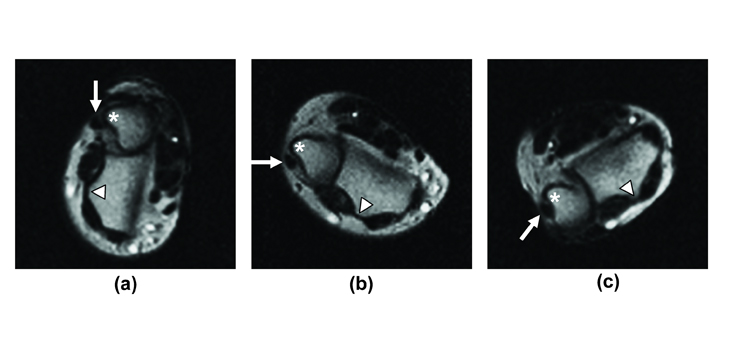
The relationship of the ECU tendon (arrow) to its groove as the forearm is rotated from (a) pronation, through (b) neutral to (c) supination – on axial images of the DRUJ using the active-MRI scan. / Courtesy: University of California Davis
Secondary

If a still picture won’t work, try a movie. Orthopedic surgeons at the University of California have learned to create “movies” of the wrist in motion—images that are useful in diagnosing the subtle changes in physiology that indicate the onset of conditions such as instability of the wrist.

The films are made by creating a series of brief magnetic resonance imaging scans—a technique they call an “active MRI.”

Philip Briggs, who reported on the work from UK’s Spire Gatwick Park Hospital, quoted Robert Boutin, M.D., lead author of the study, who said: “Now patients can reproduce the motion that’s bothering them while they’re inside the scanner, and physicians can assess how the wrist is actually working. After all, some patients only have pain or other symptoms with movement.”

Investigators believe that the imaging technique could also be used to determine what the best treatment option is and whether or not the patient requires orthopaedic surgery.

React:

Discussion

14
DS
Dr. Sarah MitchellOrthopedic Surgeon · Mayo Clinic

This is a fascinating development. In my practice we've seen similar outcomes with the revised protocol. The key differentiator seems to be patient selection criteria. Has anyone else noticed the correlation with BMI thresholds?

8
JT
James Thornton, MDSpine Fellow · HSS

Great point. I'd push back slightly on the conclusion, the sample size in the cited study is too small to draw population-level inferences. That said, the directional signal is compelling and worth a larger RCT.

5
RP
R. PatelSports Medicine · Stanford

We implemented a similar approach last year. Early results are promising but we're still gathering 12-month follow-up data. Happy to share our protocol if anyone is interested.

Join the conversation

Orthopedic professionals are discussing this. Sign in and upgrade to read every comment and add your voice.

Subscribe

Get Full Access

Read every OTW article and join member discussions for $24.99/month.

Get Full Access

Advertisement

Advertisement

Advertisement

Orthopedics This Week

The most trusted source in orthopedic industry news since 2005. Covering spine, joints, trauma, biologics, and the business of orthopedics.

A publication of RRY Publications, LLC

LinkedInXFacebook

Categories

  • Spine
  • Joints
  • Upper Extremities
  • Foot & Ankle
  • Sports Medicine
  • Pain Mgmt
  • Trauma
  • Biologics
  • Technology
  • People
  • Company News
  • Legal & Regulatory

Resources

  • Subscribe
  • Community Posts
  • Job Board
  • Press Release Opportunities
  • Power Rankings
  • About OTW
  • Advertise
  • Contact Us

Get Full Access

Unlimited articles, community posts, and Power Rankings.

Get Full Access

Plans start at $24.99/mo · Annual saves 20%

© 2026 Orthopedics This Week · RRY Publications, LLC

Privacy PolicyTerms of ServiceCookie Policy