
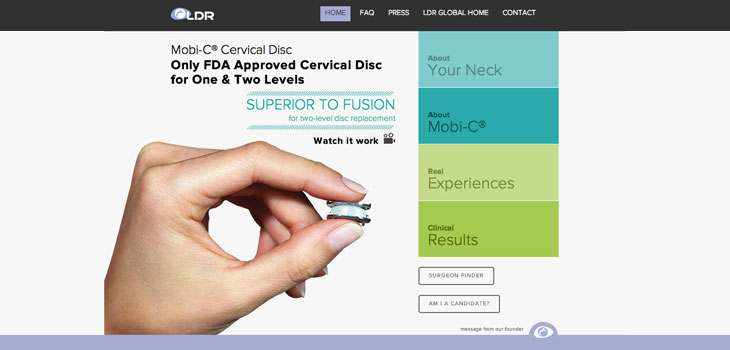
Expanding its reach, LDR Holding Corporation is announcing changes to its website, cervicaldisc.com, in order to provide balanced educational content to patients interested in learning more about cervical disc replacement.
LDR Expands Website
2 min read Premium comments
Secondary
Asked about the timing of the updates, Christophe Lavigne, president and CEO of LDR, told OTW, “Since the approval of Mobi-C for both one- and two-level cervical disc replacement in August of 2013, we have continued to develop resources and content to support Mobi-C. Cervicaldisc.com is focused on educating the patient audience with attractive, easy to understand content that can be simply browsed via a very friendly website navigation structure. We also have been conducting surgeon training programs for Mobi-C and we have added those surgeons who wish to be listed on our ‘Physician Finder’ page.”
He added, “There are a number of features that make cervicaldisc.com patient friendly. The layout is intended to be very clean and fresh, with clear navigation options. The site has been designed with very limited scrolling required to view content, and just about any piece of content can be viewed with no more than two or three clicks. Cervicaldisc.com is very rich in multimedia content. We let the patients and surgeons tell the story, and we use animations and graphs to communicate features and benefits. As the focus is on informing the diverse patient population, the text is written in very easy to understand language, and information is provided on anatomy, pathology and treatment options. Cervicaldisc.com also provides easy access to important information such as approved indications, clinical results and also adverse events.”
“To measure the success of the site, we of course track site traffic SEO metrics. Over time, we will continue to add content to the site as more tools become available and in response to any feedback that we might receive directly from patients or from the Mobi-C surgeon users.”
The Mobi-C Cervical Disc Prosthesis, the only FDA-approved disc replacement device for two levels, consists of two metal endplates and a plastic insert. The device is placed between two adjacent neck bones (cervical vertebrae) to replace the diseased discs and to stabilize the spine.
The Mobi-C Cervical Disc restores segmental motion and disc height utilizing superior and inferior Cobalt Chromium alloy endplates coated with plasma sprayed Titanium and hydroxyapatite coating, and a polyethylene mobile bearing insert. The controlled mobility of the patented mobile core is the foundation of Mobi-C, encouraging height restoration and respect of the instantaneous axis of rotation for a return to physiological mobility of the spinal segment.
Author
React:
Discussion
This is a fascinating development. In my practice we've seen similar outcomes with the revised protocol. The key differentiator seems to be patient selection criteria. Has anyone else noticed the correlation with BMI thresholds?
Great point. I'd push back slightly on the conclusion, the sample size in the cited study is too small to draw population-level inferences. That said, the directional signal is compelling and worth a larger RCT.
We implemented a similar approach last year. Early results are promising but we're still gathering 12-month follow-up data. Happy to share our protocol if anyone is interested.
Join the conversation
Orthopedic professionals are discussing this. Sign in and upgrade to read every comment and add your voice.