
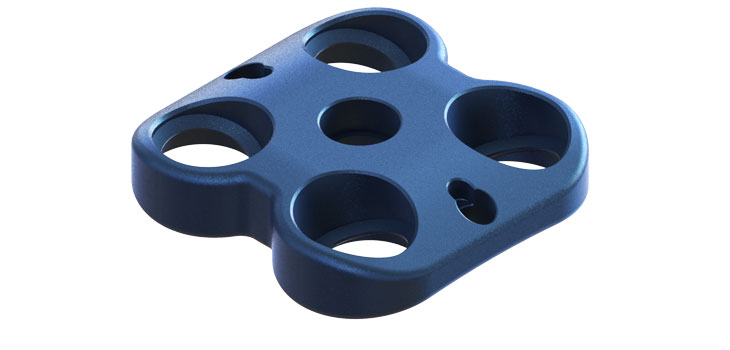
The FDA has cleared K2M, Inc.’s Cayman Minimally Invasive, (Cayman MI) the company’s latest addition to its Cayman product line of plate system.
K2M Adds to Plate System With New FDA Clearance
1 min read Premium comments
Secondary
The 510(k) clearance was announced in a January 8, 2013 press release from the company. Eric Major, K2M’s president and CEO, said the expansion of the plate systems not only enhances the company’s lateral offering, but was another example of being a worldwide leader in the minimally invasive market.
According to the company, the Cayman plate system is “a simplified solution to address fractures, tumors, and degenerative conditions in the anterior and lateral spinal column. The cleared device is a single-level, lateral plate with a low-profile, four screw construct featuring K2M’s proprietary tifix Locking Technology, a plate-screw locking technology whereby each screw head forms an autogenic lock to the plate upon insertion, requiring no additional locking mechanism. Additionally, the biased plate screw holes allow for screw angulation of 15 degrees normal to the plate.”
When “used in conjunction with K2M’s Ravine Lateral Access System, which provides a dual flat blade platform for a less invasive muscle-splitting transpsoas approach, , the company says Cayman MI “allows surgeons to preserve the position of the lateral implant and insert the plate without repositioning the Ravine retractor. The Ravine system represents an innovative design departure from the tubular retractors, while providing tremendous adaptability to both patient anatomy and surgeon technique, ” continued the company statement.
Clifford Douglas, M.D., said the Cayman MI lateral plate offers surgeons a, “truly minimally invasive and streamlined technique to perform a lateral lumbar fusion. When used in conjunction with K2M’s Ravine Lateral Access System and the Aleutian Lateral Interbody, I am able to secure the construct with the Cayman MI plate all with one single incision. Not having to worry about tissue creep and retractor position during the insertion of the plate makes this system easy to use.”
Author
React:
Discussion
This is a fascinating development. In my practice we've seen similar outcomes with the revised protocol. The key differentiator seems to be patient selection criteria. Has anyone else noticed the correlation with BMI thresholds?
Great point. I'd push back slightly on the conclusion, the sample size in the cited study is too small to draw population-level inferences. That said, the directional signal is compelling and worth a larger RCT.
We implemented a similar approach last year. Early results are promising but we're still gathering 12-month follow-up data. Happy to share our protocol if anyone is interested.
Join the conversation
Orthopedic professionals are discussing this. Sign in and upgrade to read every comment and add your voice.