
Edward C. Yang, M.D., has been named Chief of Orthopaedics at Mount Sinai Queens. Dr. Yang previously served as Regional Director of Orthopaedic Surgery at Elmhurst Hospital Center in the Queens Hospital Network. Dr. Yang is also a Professor of Orthopaedic Surgery at the Icahn School of Medicine at Mount Sinai. The appointment was announced by Brian Radbill, M.D., chief medical officer and vice president of Medical Affairs at Mount Sinai Queens.
Edward C. Yang, M.D. New Chief at Mount Sinai Queens
1 min read Premium comments
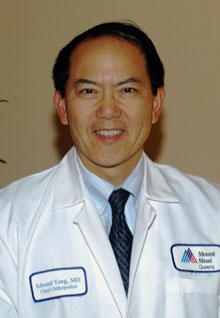
“We are delighted to welcome Dr. Yang to our staff at Mount Sinai Queens. He joins a strong team and will expand the capabilities we already have in this critically important surgical area, ” said Caryn A. Schwab, executive director, Mount Sinai Queens, in the January 6, 2014 news release.
Dr. Yang earned his medical degree from New York University School of Medicine and completed his orthopedic surgery residency at NYU’s Hospital for Joint Diseases, Orthopedic Institute.
“I am especially excited to be part of the community that is Mount Sinai Queens, ” said Dr. Yang. “There is a sense of family and that extra measure of caring one experiences in the community hospital that is so appealing to me, and that you don’t find in the larger hospital settings.”
Dr. Yang specializes in total joint replacement and fractures. He is particularly interested in geriatric trauma, especially hip fractures and is the author of numerous articles in peer-reviewed publications and is a much sought after speaker at national and international symposia. Dr. Yang is also an Honorary Police Surgeon for the New York City Police Department.
Dr. Yang told OTW, “I plan to grow, improve, and provide experienced compassionate care to the patients at Mount Sinai Queens. I want to bring my years of experience treating a broad spectrum of orthopedic conditions.”
React:
Discussion
This is a fascinating development. In my practice we've seen similar outcomes with the revised protocol. The key differentiator seems to be patient selection criteria. Has anyone else noticed the correlation with BMI thresholds?
Great point. I'd push back slightly on the conclusion, the sample size in the cited study is too small to draw population-level inferences. That said, the directional signal is compelling and worth a larger RCT.
We implemented a similar approach last year. Early results are promising but we're still gathering 12-month follow-up data. Happy to share our protocol if anyone is interested.
Join the conversation
Orthopedic professionals are discussing this. Sign in and upgrade to read every comment and add your voice.