
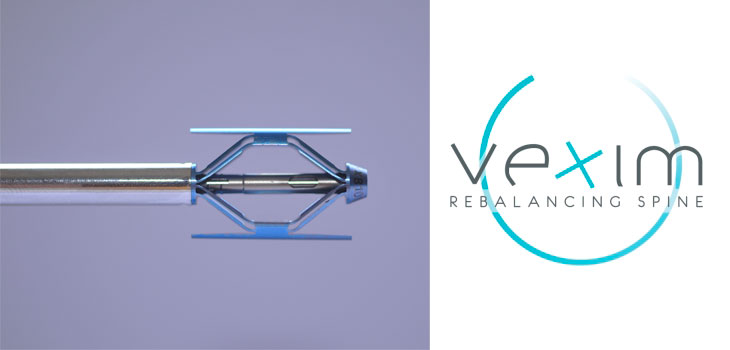
The minimally invasive team at VEXIM has just announced the launch of Interface, an innovative new biomaterial for bone fixation. Interface, meant to be used with SpineJack, is a biological alternative to existing orthopedic cements for treating traumatic vertebral fractures in patients with good bone quality. As indicated by the company, Interface preserves the existing bone tissue. The injection of this biomaterial permits optimal stabilizing of the vertebral body while facilitating bone remodeling. This osseointegration results from Interface’s specific formula, composed of 50% hydroxyapatite particles, with a formulation very close to bone structures.
VEXIM Launches Interface for SpineJack
1 min read Premium comments
Secondary
The Interface cement, developed by VEXIM, has the same physical properties as the well-known and widely used cement, Cohesion:
- Very high viscosity, reducing the risk of leakages
- Optimal working time before hardening, making it safer for surgeons to inject
- High radiopacity, allowing its deployment in the vertebra to be monitored with precision
Vincent Gardès, CEO of VEXIM told OTW, “Vexim aims at pushing the boundaries of vertebral fractures treatment by launching new products such as Interface, compatible with SpineJack. This has allowed us to equip numerous European hospitals and provide intensive training to surgeons that work with our technology. We intend to pursue this strategy to establish SpineJack as a benchmark for the treatment of vertebral compression fractures.”
React:
Discussion
This is a fascinating development. In my practice we've seen similar outcomes with the revised protocol. The key differentiator seems to be patient selection criteria. Has anyone else noticed the correlation with BMI thresholds?
Great point. I'd push back slightly on the conclusion, the sample size in the cited study is too small to draw population-level inferences. That said, the directional signal is compelling and worth a larger RCT.
We implemented a similar approach last year. Early results are promising but we're still gathering 12-month follow-up data. Happy to share our protocol if anyone is interested.
Join the conversation
Orthopedic professionals are discussing this. Sign in and upgrade to read every comment and add your voice.