
From Medical Press comes the story of attempts to ameliorate the problems caused by osteogenesis imperfecta (OI), a congenital bone disease that stunts the growth of its victims and causes repeated and painful fracturing of their bones. Ultrasound scans reveal that fetuses with this ailment, still in the womb, have fractured bones. In an experimental attempt to aid these victims of OI, in 2005 a team of researchers from Sweden (the Karolinska Institute), Singapore and Taiwan treated two babies in utero by injecting them with bone-forming stem cells. Participating institutions in Singapore were the National University Hospital, and the KK Women’s and Children’s Hospital. The collaborating partner in Taiwan was the Chang Gung Memorial Hospital in Linkou.
Stem Cell Injections Ease Osteogenesis-Imperfecta Ravage
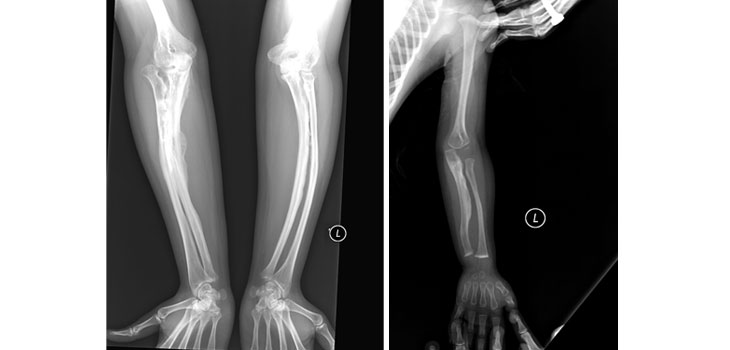
The cells came from the livers of donors who bore no relation to the infants, and so were not matched genetically. Nevertheless there was no rejection and the fetus’s bodies accepted the transplanted cells.
One subject was a female fetus from Sweden. After her birth she suffered a great many bone fractures and developed scoliosis up to the age of eight. The researchers then decided to give her a fresh stem cell graft from the same donor. Over the next two years the girl experienced no new fractures and improved her growth rate. Today she takes dance lessons and participates in physical education at her school.
The Karolinska Institute team and its colleagues also gave another unborn baby with OI, a female infant from Taiwan, stem cell transplantation. The girl followed a normal and fracture-free growth trajectory for the first year of her life. Then her progress leveled off. When the doctors gave her a fresh stem cell treatment her growth resumed. She began walking and has since not suffered any new fractures. Today she is four years old.
Study leader Cecilia Götherström, M.D. researcher at Karolinska Institutet’s Department of Clinical Sciences, Intervention and Technology, told the writer for Medical Press, “We believe that the stem cells have helped to relieve the disease since none of the children broke bones for a period following the grafts, and both increased their growth rate. Today, the children are doing much better than if the transplantations had not been given. OI is a very rare disease and lacks effective treatment, and a combined international effort is needed to examine whether stem cell grafts can alleviate the disease.”
The researchers learned of a boy from Canada who was born with OI caused by the same mutation as that experienced by the Swedish girl. The boy was not given stem cell therapy and was born with severe and widespread bone damage, including numerous fractures and kyphosis of the thoracic vertebrae. This caused such over-curvature of the spine that it impaired his breathing. The boy died of pneumonia within his first five months. The longitudinal results of the treatment are published in the journal Stem Cells Translational Medicine.
Author
Discussion
This is a fascinating development. In my practice we've seen similar outcomes with the revised protocol. The key differentiator seems to be patient selection criteria. Has anyone else noticed the correlation with BMI thresholds?
Great point. I'd push back slightly on the conclusion, the sample size in the cited study is too small to draw population-level inferences. That said, the directional signal is compelling and worth a larger RCT.
We implemented a similar approach last year. Early results are promising but we're still gathering 12-month follow-up data. Happy to share our protocol if anyone is interested.
Join the conversation
Orthopedic professionals are discussing this. Sign in and upgrade to read every comment and add your voice.