
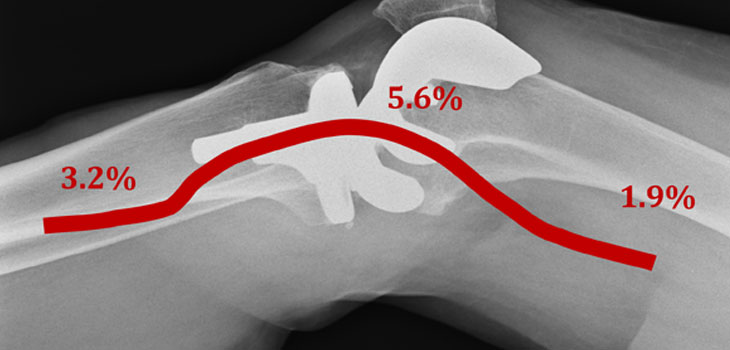
Market Research Reports, Inc. make good reading when they deal with the world-wide knee replacement market. The market value of knee replacement is expected to increase over the next few years from $6.544 billion in 2012 to $7.459 billion by 2019 which represents a compound annual growth rate of 1.9%.
New Report: Global TKA Growth Rate Down to 1.9%
1 min read Premium comments
Secondary
The United States had the largest market share in 2012 at 63%, followed by France, Germany, Italy, Spain, the UK, Japan, Brazil, China and India. According to analysts, “The knee replacement market represents the largest joint reconstruction market in the world. Although it has continued to grow at a steady rate in procedure volume, profit margins have been negatively affected by health executives scrutinizing purchases and using multiple channels to procure orthopedic devices at highly competitive prices.”
The driver of the expected growth is the rising prevalence of symptomatic arthritis. Researchers believe that emerging markets, such as India and China, will see a higher growth level in knee replacement and will provide the key for players to gain additional market share.
One analyst wrote, “As the knee replacement procedure volume rises over the next decade, it will become increasingly important to improve surgical accuracy and reduce revision rates to a specific level. Future competition among vendors will thus be more likely to center on the instrumentation and ancillary equipment, such as patient-specific instruments, navigation systems, and robotic systems.”
Another researcher noted that current economic conditions are forcing patients to reconsider hip and knee replacements due to the costs involved. Knee replacement is more likely to be deferred by patients than is hip replacement, he said, because medical treatments, such as viscosupplementation, can, at least for a time, ease the pain in knees.
Author
React:
Discussion
This is a fascinating development. In my practice we've seen similar outcomes with the revised protocol. The key differentiator seems to be patient selection criteria. Has anyone else noticed the correlation with BMI thresholds?
Great point. I'd push back slightly on the conclusion, the sample size in the cited study is too small to draw population-level inferences. That said, the directional signal is compelling and worth a larger RCT.
We implemented a similar approach last year. Early results are promising but we're still gathering 12-month follow-up data. Happy to share our protocol if anyone is interested.
Join the conversation
Orthopedic professionals are discussing this. Sign in and upgrade to read every comment and add your voice.