
Necessity is the mother of invention.
In This Case: Don’t Walk It “Off”
2 min read Premium comments
Secondary
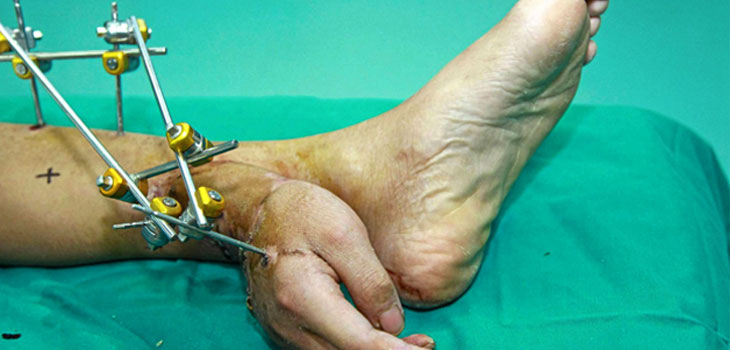
If a picture is worth 1, 000 words then this one is worthy of many more.
From Changsha, Hunan Province of China, comes the story of Xiao Wei who lost his right hand in an industrial accident and the team of surgeons who didn’t let a “flattened” arm stop them from saving a severed hand.
As described by the patient Wei, “I was just shocked and frozen to the spot until colleagues unplugged the machine and retrieved my hand and took me to the hospital. I am still young, and I couldn’t imagine life without a right hand.”
Most accidental amputations result from the traumatic interaction of human limb and machinery. These high speed machines mangle, crush and rip limbs almost instantaneously which, to some degree, spares the patient some pain but creates incredibly complex repair problems for surgeons. Indeed, most of interactions between modern industrial machines and human limbs make reattachment impossible.
It has been 50 years since the first successful limb reattachment surgery and, as Wei’s case illustrates, the problems have not changed. Just the solutions.
Fifty-one and a half years ago, May 1962, 12-year-old Everett Knowles, Jr. tried to “hop a train” and missed. He fell and his shoulder landed under the train’s wheel where his arm was literally ripped off from his shoulder. The accident happened near Boston and he was rushed to Mass General hospital. The surgical team decided to try to reattach the severed arm.
Before Knowles, there had never been a documented case of a full reattachment of a completely severed limb on a human. On dogs, yes. But not humans.
Knowles, however, was a good candidate. He was young, His arm was on ice. So they went to work.
The team’s first concern was the health of the severed arm. It had not had blood supply for a while. How much was still salvageable? Immediately after cleaning the limb the team set about re-establishing blood supply and reconnected arteries and veins. That was the end of surgery #1.
Over the next few months, the team went back in again and again to systematically reattach bone, muscle, nerve bundles and skin. Nerves were attached last.
In the years that followed, Knowles regained use of his once-dominant right hand, and was eventually able to use it as well as a natural southpaw uses a right hand.
The team in China was faced with a much less promising candidate than 12-year-old Knowles from 50 years ago. As often happens with industrial accidents, the arm was severely compromised. So much so that restoring a blood supply was impossible. Unless….
The Changsha hospital surgical team tried something extraordinary and logical. They sewed the severed hand to Wei’s ankle using those arteries and veins to feed the hand. Wei’s doctor told a reporter for Sky News HD, “His injury was severe. Besides ripping injuries, his arm was also flattened. We had to clear and treat his injuries before taking on the hand reattachment surgery.”
The ankle’s blood supply kept Wei’s hand alive while his arm recovered. It took a month.
Wei walked his hand into the hospital and the surgical team removed it from the ankle and reattached it to his arm. Because of his doctor’s innovative approach, Xiao Wei’s hand was saved. By all indications, Wei should regain full use of his hand.
Author
React:
Discussion
This is a fascinating development. In my practice we've seen similar outcomes with the revised protocol. The key differentiator seems to be patient selection criteria. Has anyone else noticed the correlation with BMI thresholds?
Great point. I'd push back slightly on the conclusion, the sample size in the cited study is too small to draw population-level inferences. That said, the directional signal is compelling and worth a larger RCT.
We implemented a similar approach last year. Early results are promising but we're still gathering 12-month follow-up data. Happy to share our protocol if anyone is interested.
Join the conversation
Orthopedic professionals are discussing this. Sign in and upgrade to read every comment and add your voice.