
“I used to extoll the virtues of the modular neck, ” says David Blaha. “I’ve changed my mind because the risks have increased. The problem is corrosion.” John Keggi retorts, “Let’s not throw the baby out with the bath water. Modular stems do allow you to reconstruct femurs that you might not be able to reconstruct with a standard stem…and deformities that you definitely cannot reconstruct with a standard stem.”
Blaha, Keggi Debate Femoral Neck Modularity
8 min read Premium comments
Great Debates
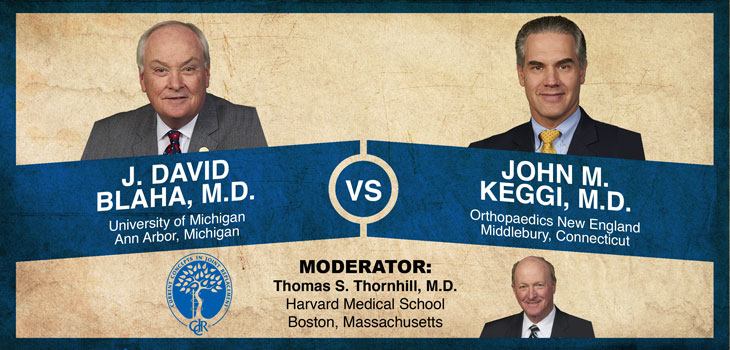
This week’s Orthopaedic Crossfire® debate is “Femoral Neck Modularity: A Bridge Too Far.” For the proposition is J. David Blaha, M.D. of the University of Michigan in Ann Arbor; against the proposition is John M. Keggi, M.D. from the Orthopaedics New England in Middlebury, Connecticut. Moderating is Thomas S. Thornhill, M.D. from Harvard Medical School in Boston.
Dr. Blaha: “Tom will remember that I’ve stood up here and extolled the virtues of the modular neck, saying that it allows us to put the head where it’s supposed to be relative to the musculature…so that each of the muscles finds the same lever arm that it would expect, thus providing a more functionally adequate result.”
“I’ve also suggested that while fractures occurred, they only occurred in really heavy people with long modular necks. In the past, I believed that the short neck in a normal weight person was the reasonable thing to do. I’ve changed my mind because the risks have increased. The problem is corrosion…it eats away the material.”
“Now we’re looking at modularity in two sections, both at the top and at the bottom of the neck—which combines the worst of both worlds. Every orthopedic alloy corrodes the minute you expose it to air—it oxidizes. This ‘passivates’ the material, and if the passivation layer is left intact then very little further corrosion occurs. However, the modular neck is placed in a mechanically disadvantageous environment, and the loads can cause it to move relative to the pocket…and this can remove some of the passivation layer.”
“The process continues at that layer, and in the process it produces titanium, hydrogen gas, and chloride ions, which decrease the thickness of the passivation layer. Hydrogen gas can form below the implant, and this whole mechanically assisted or accelerated crevice corrosion is the problem with modular junctions.”
“We can change this by changing the material and structure of the neck and the stem, the length of the neck, size of the head, and the loads from the patient. The corrosion can make it difficult to remove the neck. We’ve had several cases where unexplained gas looked like infection. We aspirated the gas and it proved to be hydrogen gas. After we got to the point of removing the neck, applying the slap hammer to the neck led to a significant explosion in the OR…indicating that hydrogen gas had probably exploded.”
“My first modular neck fracture had this gas and I didn’t recognize that the gas from that corrosion was there. He felt a creaking and a snap. I thought it was because he was big and had a long modular neck.”
“Problems of corrosion/fracture happen at all modular junctions. When modularity is absolutely necessary designs should have the best loading environment and maximum possible strength. Changing the material to cobalt might be a problem. It is stronger and it probably has less damage by corrosion. By changing the shape and the length of the titanium alloy neck some companies have suggested that they could make a modular neck that works better. The cobalt chromium in the beta alloy of titanium was suggested last year, but that has been withdrawn from the market.”
“Modular necks allow you to uncouple the position of the stem from the head, you can find that ‘sweet spot, ’ and you have clearance to do surgery through smaller portals. The disadvantages are corrosion, hydrogen embrittlement, pits in notch-sensitive titanium can lead to fracture, and hydrogen pneumarthrosis. A full 85% of modular necks I used were the same ones, so I only needed the modular necks in 15% of my cases.”
“Failure of the modular neck causes damage to the pocket. The only sure way to remove the problem is to remove the well-fixed stem, but that is a significant problem for the patient. In conclusion, 66-year-old orthopedists should leave experimentation that requires long-term follow-up to the young surgeons.”
Dr. Keggi: “The blood is in the water on modularity and the sharks are circling. Now we certainly can recognize that there are modular failures. Dr. Josh Jacobs’s group recently reported on their Rejuvenate experience and Dr. Padgett commented that it is the BIO in biomechanics that is at work in some of these modular failures.”
“But there are also modular successes. And modular stems do in fact allow you to reconstruct femurs that you might not be able to reconstruct with a standard stem…or deformities that you definitely cannot reconstruct with a standard stem. Human anatomy follows a bell curve and standard stems do not.”
“Other local factors can play a role. Femoral tilt—the angle of degree you put the stem in the femur—can change anteversion dramatically. Even 10 degrees of femoral tilt in the saggital plane can change the anteversion 5 or more degrees. That has the effect of decreasing the impingement free range of motion of the hip by more than 50%.”
“Also, by reducing offset, function and pain are affected. In a 2012 study Cassidy et al. found that when they reduced offset by more than 5mm patients had more pain and less function. Dislocation rate is positively affected by modularity. In our 2006 study of 2, 248 modular THAs [total hip arthroplasty] the dislocation rate was less than 1% across multiple centers, surgeons, and approaches.”
“Our modular neck experience with one particular brand showed that two-thirds of patients received an angled neck…and that provided the optimum range of motion and stability for the hip. But not all modular junctions are created equal. Some demonstrate dramatically higher rates of fretting, and neck stresses can change with subtle changes in varus/valgus positioning or design.”
“There is a difference in modular stems based on their length and design. Also, how they bind in the well varies; some bind on the flat side and some bind on the curves, with the latter being more effective and stable. How much of the neck you preserve is important. Neck preservation also has the benefit of decreasing stresses in the prosthetic neck by 35%. So if you retain the femoral neck you reduce stresses. Assembly technique is critical—you must impact these forcefully and well.”
“Revision is a concern, but my experience in removing 15 consecutive modular stems required no ETOs (extended trochanteric osteotomies) at all. In fact, if you use a neck-sparing stem then revision is easy. The neck-sparing stem has most of its fixation proximally. You can then perform a standard primary total hip osteotomy. That leaves very little fixation remaining, which can be easily addressed with the pencil burr. Then you can change that to a primary stem. So early revision is not a concern.”
“We’ve looked at cobalt and chromium levels in 25 of our patients with a cobalt-chrome neck modular junction, and found the levels to be acceptable. And the U.S. experience with this stem has resulted in seven explanted stems and no evidence of corrosion or adverse local tissue reaction. So let’s not throw the baby out with the bath water. We have modular necks, hip resurfacing, ceramics, uncemented knees, all of which have had their trials and tribulations in the past. But the current modular necks may be guilt by association.”
“The ideal system is one that allows a monoblock option for the most common sizes, but also lets you go modular when you need it. You need a sturdy taper and a neck-sparing stem (to reduce stress at the modular junction), and you must assemble it well. And it must be well tested.”
Moderator Thornhill: “If we’re talking about the modularity that involves the morse taper between the ball and the stem…do you use that or pure monoblock?”
Dr. Blaha: “I prefer monoblock, but I can’t get that anymore, so I use modularity at the head/neck junction. And a 12/14 taper is the one that comes out most of the time.”
Moderator Thornhill: “How about the type of modularity that changes the anteversion/retroversion, i.e., in the body of it?”
Dr. Blaha: “There has been some corrosion at that junction as well. It’s not as mechanically disadvantaged, so the mechanically accelerated crevice corrosion probably isn’t as bad. I haven’t used that, but I have no reason to say that it’s not a good thing to do.”
Moderator Thornhill: “What modularity would you not use…other than the implant that’s been removed?”
Dr. Keggi: “I would not hesitate to use it in order to achieve the restoration of the hip. I would use proximal modularity (head on the neck) or the neck on the stem.”
Moderator Thornhill: “So if you have someone who has DDH…60 degrees of anteversion of the femoral component, how do you deal with that?”
Dr. Blaha: “I’d use a Wagner type conus stem in which I can choose the position in the medullary canal and not have to use modularity.”
Moderator Thornhill: “In the Australian registry the incidence of dislocation was actually higher in the modular necks than non-modular necks. I don’t remember if it was late or early. Late could be due to corrosive wear and loosening of soft tissues.”
Dr. Keggi: “It could. Certainly with the soft tissue damage late dislocation can be a sign of that. But that may be device-dependent. So it may be one of these same designs that turns out to have a high corrosion rate, flexible metal, or binding at different points in the well that aren’t as stable as others.”
Moderator Thornhill: “Impaction is interesting because we all do it differently. Should we be more concerned about our impaction technique?”
Dr. Keggi: “We should impact it as tightly as possible in the modular junction. When it comes to impacting a ceramic head that’s a whole separate issue.”
Dr. Blaha: “At Wright they looked at this and hand-assembled modular necks in a corrosion environment and they go to corrosion right away. Well assembled ones had very little corrosion. When we put this in, if we’re using a modular neck and the head isn’t directly on with the taper, the standard was to put the head on and then put the taper in and hit that three times. We may not have been driving along the axis of the modular neck, and we may have been galling instead of setting the taper. It may be that the taper junction isn’t as prone to corrosion as we thought…if we set it correctly.”
Dr. Keggi: “Sometimes people are concerned about the implant being a splitting wedge in the proximal femur, and maybe backed off their impaction of the femoral neck into the stem. If you’re really concerned about it you could prophylactically wire the proximal femur before impaction.”
Dr. Blaha: “That might mean we should assemble it before putting it in the patient, which means it becomes a fixed neck stem.”
Moderator Thornhill: “Thank you both.”
Please visit www.CCJR.com to register for the 2013 CCJR Winter Meeting, December 11–14 in Orlando, Florida.

“You may now view CCJR meeting content on your mobile device on the CCJR MobileTM App. Please scan the QR code to download from iTunes.”
React:
Discussion
This is a fascinating development. In my practice we've seen similar outcomes with the revised protocol. The key differentiator seems to be patient selection criteria. Has anyone else noticed the correlation with BMI thresholds?
Great point. I'd push back slightly on the conclusion, the sample size in the cited study is too small to draw population-level inferences. That said, the directional signal is compelling and worth a larger RCT.
We implemented a similar approach last year. Early results are promising but we're still gathering 12-month follow-up data. Happy to share our protocol if anyone is interested.
Join the conversation
Orthopedic professionals are discussing this. Sign in and upgrade to read every comment and add your voice.