
Baxano Surgical, Inc. is ending the year on reimbursement and clinical high notes.
Baxano Receives Medicare Boost and Clinical Publication
2 min read Premium comments
Secondary
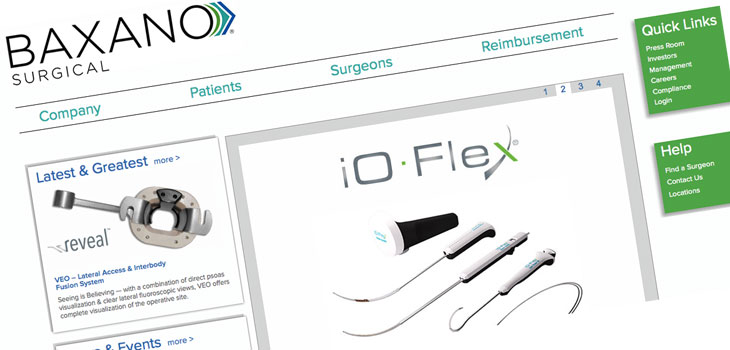
On December 6, 2013, the company announced the publication of two clinical studies on the AxiaLIF Plus presacral access and interbody fusion system and the iO-Flex minimally invasive decompression instrument. Both studies are featured in the December 1 edition of the Journal of Spinal Disorders and Techniques.
18.8% RVU Increase
Six days later, the company announced that the 2014 Medicare Final Physician Fee Schedule Rule released in late November revises upward the Practice Expense Relative Value Units (PERVUs) for Current Procedural Terminology (CPT) Code 22586 for pre-sacral interbody fusion. The total Relative Value Units (RVUs) for CPT Code 22586 are 53.76 in 2014, an 18.8% increase over 2013.
AxiaLIF Plus Versus ALIF
The first paper describes a head-to-head study by two independent spine surgeons comparing AxiaLIF Plus to ALIF in 96 total patients. AxiaLIF Plus 1-Level (L5-S1) with pedicular fixation was compared to ALIF (anterior lumbar interbody fusion) at L5-S1 with pedicular fixation and was authored by Peter G. Whang, M.D., associate professor of Orthopaedics and Rehabilitating at Yale University. All patients had two years or greater follow up with thin slice CT scans.
In the surgeons’ combined review, AxiaLIF Plus demonstrated higher fusion rates than ALIF, although the difference was not statistically significant. Further, the AxiaLIF cohort experienced no serious adverse events, compared with the ALIF cohort, in which one serious adverse event was reported.
Dr. Whang said, “Based upon our clinical and radiographic review, the safety and efficacy of the AxiaLIF procedure appears to be comparable to that of ALIF when used in conjunction with posterior instrumentation, suggesting that this less invasive technique is a viable method for achieving an interbody fusion across the lumbosacral junction.”
iO-Flex Data
The second paper describes data from a prospective, observational study on 59 subjects who underwent a facet-sparing decompression using the iO-Flex minimally invasive decompression instrument for lumbar spinal stenosis. Operative technique, operative data and surgical adverse events were evaluated. With the iO-Flex instrument there were no device-related operative complications. A subset of patients were evaluated radiographically using CT scans, access to the lateral recess and foramen was achieved with removal of less than 6% of the superior facet cross-sectional area. The study was authored by Lawrence M. Dickinson, M.D., from Pacific Brain and Spine.
“We have shown that the iO-Flex instrument coupled with standard surgical technique comprehensively decompresses the central canal, lateral recess and far lateral foramen while preserving the facet anatomy, thus limiting the cause of future instability. Symptom resolution, including back pain has been very impressive. The fact that iO-Flex preserves the posterior anatomy should result in a much lower incidence of instability and reoperation rate, ” stated Dr. Dickinson.
Baxano Surgical, Inc. is the result of a May 2013 merger between TranS1, Inc. and Baxano Inc.
Author
React:
Discussion
This is a fascinating development. In my practice we've seen similar outcomes with the revised protocol. The key differentiator seems to be patient selection criteria. Has anyone else noticed the correlation with BMI thresholds?
Great point. I'd push back slightly on the conclusion, the sample size in the cited study is too small to draw population-level inferences. That said, the directional signal is compelling and worth a larger RCT.
We implemented a similar approach last year. Early results are promising but we're still gathering 12-month follow-up data. Happy to share our protocol if anyone is interested.
Join the conversation
Orthopedic professionals are discussing this. Sign in and upgrade to read every comment and add your voice.