
Repeated blows to the head during a season of contact sports may cause changes in the brain’s white matter and affect cognitive abilities even if none of the impacts resulted in a concussion, according to a recent study published in the journal Neurology.
All Head Blows May Be Hazardous
1 min read Premium comments
Secondary
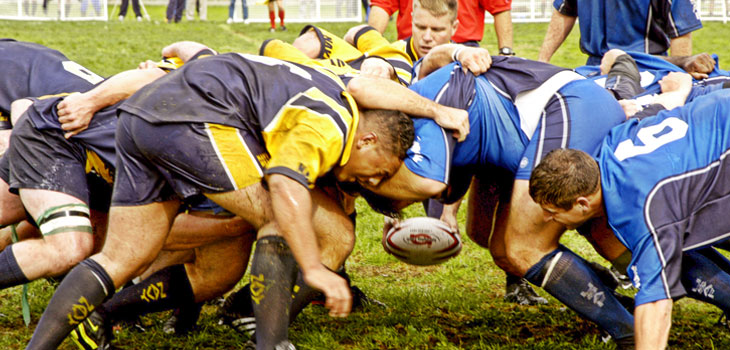
Thomas W. McAllister, M.D., chair of the Indiana University (IU) Department of Psychiatry, reported on his study in which investigators studied and compared 80 football and ice hockey players—who formed the contact sports group—with 79 athletes taken from noncontact sports such as track, crew and Nordic skiing. The contact sports players wore helmets with accelerometers in them so that researchers could track the number and severity of impacts the players received to their heads. The analysis did not include any players who had sustained a concussion during that season of play.
When researchers administered MRI’s to the students at the end of the season they found that there were significant differences in the brain white matter of varsity football and hockey players when they compared them with the group of noncontact-sport athletes. (White matter is composed primarily of axons, the long fibers that transmit signals between neurons.)
“The contact sports and noncontact-sports groups differed, and the number of times the contact sports participants were hit, and the magnitude of the hits they sustained, were correlated with changes in the white matter measures, ” said McAllister. “In addition, there was a group of contact sports athletes who didn’t do as well as predicted on tests of learning and memory at the end of the season, and we found that the amount of change in the white matter measures was greater in this group.”
When the researchers gave the participating athletes the California Verbal Learning Test II, which is a measure of verbal learning and memory, they did not find “large-scale, systematic differences” in the brain scan measures. This was “somewhat reassuring” and consistent with the fact that, historically, many players have participated in contact sports throughout their lives without developing neurodegenerative disorders.
Author
React:
Discussion
This is a fascinating development. In my practice we've seen similar outcomes with the revised protocol. The key differentiator seems to be patient selection criteria. Has anyone else noticed the correlation with BMI thresholds?
Great point. I'd push back slightly on the conclusion, the sample size in the cited study is too small to draw population-level inferences. That said, the directional signal is compelling and worth a larger RCT.
We implemented a similar approach last year. Early results are promising but we're still gathering 12-month follow-up data. Happy to share our protocol if anyone is interested.
Join the conversation
Orthopedic professionals are discussing this. Sign in and upgrade to read every comment and add your voice.