
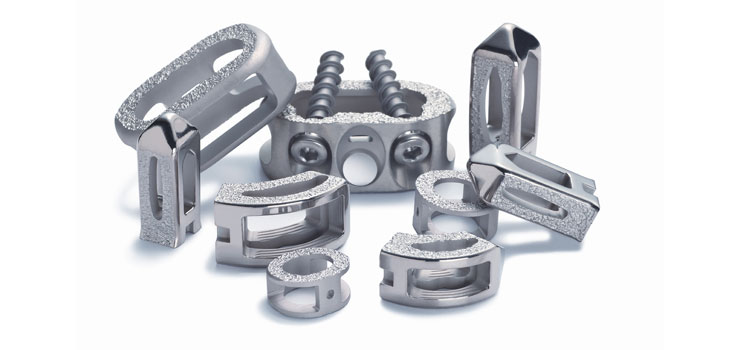
Titan Spine, LLC’s Endoskeleton interbody fusion devices with their unique roughened surface technology have now been implanted 18, 000 times and are approaching a $20 million in annualized sales revenue run-rate.
Titan Spine’s Rough Technology Reaches Smooth Milestones
2 min read Premium comments
Secondary
A company announcement on November 11, 2013 stated the two achievements mark a, “paradigm shift toward devices engineered with roughened titanium surface technology.”
Roughened Surface Technology
The devices feature Titan’s proprietary implant surface technology, consisting of a unique combination of roughened topographies at the macro, micro, and cellular levels. The company says the combination of surface levels is designed to create an optimal host-bone response and actively participate in the fusion process by promoting new bone growth, encouraging natural production of bone morphogenetic proteins (BMPs) and creating the potential for a “faster and more robust fusion.”
In addition, the company provided the following updates:
- Currently implanting more than 5, 300 implants per year
- Greater than 150 surgeon customers
- Exceeding 60 U.S. distributors
- 40% year-over-year revenue growth for the nine-month period ended September 30, 2013
- No Medical Device Reports (MDR’s) since the company’s inception
- Recent distribution agreement with Biomet Spine is expected to accelerate sales growth in Germany
Cell Signaling Properties
Kade Huntsman, M.D., orthopedic spine surgeon with the Salt Lake Orthopaedic Clinic in Salt Lake City, Utah, said one of the reasons he believes Titan’s interbody devices have resonated well with surgeons is because of the strength and design of the implant combined with the cell signaling properties of its surface technology. “I like that its roughened surface technology is created from a reductive process and does not possess a coating that could have the potential for delamination or degradation.”
Addressing Shortcomings of PEEK
Titan’s President Kevin Gemas said he is encouraged to see several other companies adopting the Titan Spine approach by launching interbody devices with roughened surfaces. He said those companies are beginning to acknowledge “shortcomings with their standard PEEK and smooth titanium offerings.” He added that Titan has been optimizing its surface technology and its bone formation effects for the past six years through collaboration with thought leaders in materials science and biomedical engineering. “[We] feel that our commitment to be the leaders in surface technology is the reason we are starting to see rapid acceleration in our sales growth.”
Titan Spine is located in Mequon, Wisconsin and Laichingen, Germany. The company markets a full line of interbody devices featuring its proprietary textured surface through its sales force and a network of independent distributors.
Author
React:
Discussion
This is a fascinating development. In my practice we've seen similar outcomes with the revised protocol. The key differentiator seems to be patient selection criteria. Has anyone else noticed the correlation with BMI thresholds?
Great point. I'd push back slightly on the conclusion, the sample size in the cited study is too small to draw population-level inferences. That said, the directional signal is compelling and worth a larger RCT.
We implemented a similar approach last year. Early results are promising but we're still gathering 12-month follow-up data. Happy to share our protocol if anyone is interested.
Join the conversation
Orthopedic professionals are discussing this. Sign in and upgrade to read every comment and add your voice.