
An independent evaluation comparing Benvenue Medical, Inc.’s Kiva VCF (vertebral compression fracture) system to balloon kyphoplasty found that Kiva delivered “significant improvements in back pain.”
Kiva Coils Beat Medtronic Balloons in VCF Study
2 min read Premium comments
Secondary
The Pain Physician Journal, the official publication of the American Society of Interventional Pain Physicians, published the results of the peer-reviewed study in the September/October edition of the journal.
The study, titled “Comparison of Balloon Kyphoplasty with the New Kiva VCF System for the Treatment of Vertebral Compression Fractures, ” was conducted on the basis of matched pairs, with 52 patients suffering from 68 osteoporotic fractures and followed for six months.
Less Pain, Fewer New Fractures and Less Cement
Those treated with balloon kyphoplasty were treated with KyphX-Systems by Medtronic, Inc., the current gold standard of care and most common vertebral augmentation treatment in the U.S. Outcome measurements were Visual Analog Scale (VAS, a measure of pain), Oswestry Disability Index (ODI, a measure of function), cement usage, cement extravasation, height restoration, and new fractures. The study concluded several statistically significant outcomes in favor of Kiva over balloon kyphoplasty:
- Pain improvement was significantly better with Kiva at six months (p < 0.0001)
- New fractures following treatment with Kiva were significantly lower, 12%, than after balloon kyphoplasty, 54% (p < 0.0001)
- Mean cement used was less than half with Kiva (2.2 – 2.6 mL) vs. balloon kyphoplasty (4.7 – 7.5 mL)
In an October 29, 2013 company press release, Lucia Otten, M.D., of University Hospital in Bonn, Germany, and author of the study said, “Historically, balloon kyphoplasty has offered my osteoporotic VCF patients benefits. We evaluated Kiva as a new treatment option to see if those benefits were improved. Patients in our study treated with Kiva experienced a pronounced improvement in back pain over balloon kyphoplasty. Additionally, patients treated with Kiva demonstrated a lower incidence of newly occurring fractures and we used less than half the cement.”
“This study indicates that using Kiva to treat VCFs offers statistically significant advantages over balloon kyphoplasty in addressing pain, as well as in improving longer-term results by reducing future fractures, ” added Robert Pflugmacher, M.D., professor of surgery at the same hospital.
The company announcement said that although not demonstrated in this study to be a statistically significant difference, cement extravasation was less with Kiva (23%) vs. balloon kyphoplasty (31%). Vertebral height restoration and functional improvement were equivalent in both groups.
Robert Weigle, Benvenue’s CEO, said this is the first independent study to show that the Kiva system was better at improving pain and reducing subsequent fractures in patients with VCFs than balloon kyphoplasty. But it’s the second to show significant clinical advantages of using Kiva over balloon kyphoplasty.
Kiva System
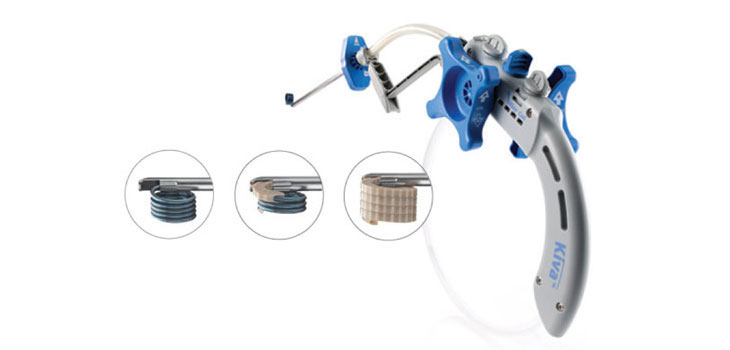
The Kiva system features a proprietary flexible implant made from PEEK-OPTIMA. The Kiva implant is designed to function as a mechanical support structure and a reservoir to contain and direct the flow of bone cement.
According to the company, the implant is delivered percutaneously in a continuous loop into the vertebral body through a small diameter, single incision. The amount of the implant delivered can be physician-customized during the procedure to adjust to various fracture types. Delivered over a removable guidewire, the implant is designed to provide structural support to the vertebral body and to directionally control and contain bone cement.
Author
React:
Discussion
This is a fascinating development. In my practice we've seen similar outcomes with the revised protocol. The key differentiator seems to be patient selection criteria. Has anyone else noticed the correlation with BMI thresholds?
Great point. I'd push back slightly on the conclusion, the sample size in the cited study is too small to draw population-level inferences. That said, the directional signal is compelling and worth a larger RCT.
We implemented a similar approach last year. Early results are promising but we're still gathering 12-month follow-up data. Happy to share our protocol if anyone is interested.
Join the conversation
Orthopedic professionals are discussing this. Sign in and upgrade to read every comment and add your voice.