
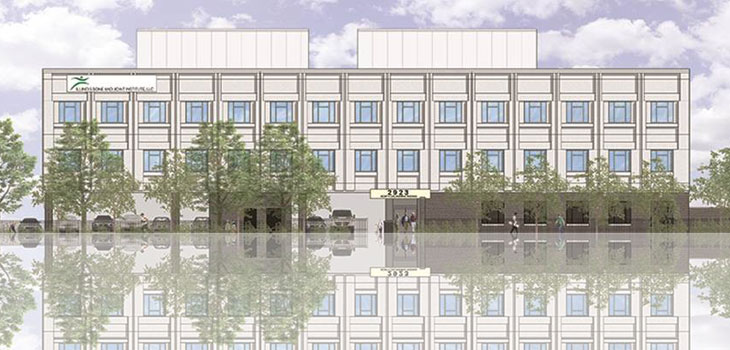
Illinois Bone & Joint Institute (IBJI) has just cut the ribbon on a new location in Chicago’s Logan Square/Avondale neighborhood. The facility boasts18, 000 sq. ft. and offers a full range of orthopedic specialty care for children and adults, as well as rehabilitation services, physical and occupational therapy, and work conditioning for injured workers. Additionally, IBJI offers radiologist-performed arthrograms and diagnostic imaging, including advanced x-ray technology, MRI and high-field MRI (coming in early 2014). Lastly, orthopedic immediate care services are available through OrthoAccess, a faster, more affordable, high quality alternative to a hospital emergency room for minor orthopedic injuries.
Illinois Bone & Joint Institute Opens New Location
1 min read Premium comments
Secondary
The facility was designed specifically for IBJI, and offers additional treatment space with better patient flow and more efficient work flow for staff, enhancing IBJI’s standard for coordinated, integrated delivery of excellent patient care.
The centralized care center accommodates patients seeking orthopedic care including:
- Joint reconstruction and replacement
- Hand, elbow, shoulder, and spine care and surgery
- Hip, knee, foot and ankle care and surgery
- Pain management
- Sports medicine, including children’s and women’s sports medicine
IBJI is one of the first area specialty physician groups to offer advanced diagnostic imaging featuring the latest radiology software tools. New hardware technology enables X-rays while patients are standing or sitting, eliminating the need to move patients on and off an x-ray table, particularly helpful to older patients. The new technology processes digital images more clearly and much faster, and images can be transmitted to a physician’s mobile or Internet connected device anywhere in the world in just seconds.
Wayne Goldstein, M.D. is president, CEO, and founder of Illinois Bone & Joint Institute. He told OTW, “The timing was right for this endeavor because we saw an opportunity to reach communities in Chicago with a facility in which patients can obtain all services usually associated with a hospital in an easily accessible environment.”
React:
Discussion
This is a fascinating development. In my practice we've seen similar outcomes with the revised protocol. The key differentiator seems to be patient selection criteria. Has anyone else noticed the correlation with BMI thresholds?
Great point. I'd push back slightly on the conclusion, the sample size in the cited study is too small to draw population-level inferences. That said, the directional signal is compelling and worth a larger RCT.
We implemented a similar approach last year. Early results are promising but we're still gathering 12-month follow-up data. Happy to share our protocol if anyone is interested.
Join the conversation
Orthopedic professionals are discussing this. Sign in and upgrade to read every comment and add your voice.