
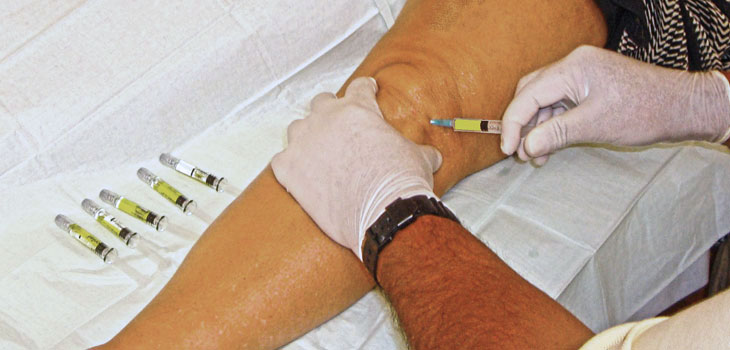
Patients with osteoarthritis whose doctors gave them injections of hyaluronic acid were able to delay total knee replacement for up to 2.6 years longer than could those who did not have the injections, according to Nancy Walsh, staff writer for MedPage Today.
Hyaluronic Acid Injections Delay TKA
1 min read Premium comments
Secondary
Walsh quoted Roy D. Altman, M.D., University of California, Los Angeles as saying, “It’s important to delay total knee replacement as much as possible, particularly in younger patients, because it isn’t a cure-all and the joint survival is only about 9 to 10 years before they have to have revision surgery.” He added that about one-third of patients continue to experience pain in their knee following TKA (total knee arthroplasty) surgery.
Altman and his colleagues analyzed data on 26, 627 patients who had been diagnosed with osteoarthritis and had a total knee replacement. They found that 7, 000 patients had received at least one injection of hyaluronic acid prior to their surgery.
From the group of 19, 627 patients who had not received injections, they selected 6, 891 as propensity-score matched controls. Two-thirds were women, most of whom were in the age range of 55 to 59.
The researchers found that 79% of the patients had undergone a single injection of hyaluronic acid, 16% had had two, 4% had had three, and 1% had had four or more. The median number of days until they had total knee replacement, according to the number of injections they received, was 162 days for the one injection group, 584 days for the three injection group and 740 for those who received four injections. Altman reported on his study at a poster session at the annual meeting of the American College of Rheumatology.
More than 27 million U.S. adults currently have knee osteoarthritis. Hyaluronic acid injections have been found to help restore intra-articular synovial fluid function and improve clinical outcomes, but the impact on the need for joint replacement had not previously been examined, according to Walsh.
Author
React:
Discussion
This is a fascinating development. In my practice we've seen similar outcomes with the revised protocol. The key differentiator seems to be patient selection criteria. Has anyone else noticed the correlation with BMI thresholds?
Great point. I'd push back slightly on the conclusion, the sample size in the cited study is too small to draw population-level inferences. That said, the directional signal is compelling and worth a larger RCT.
We implemented a similar approach last year. Early results are promising but we're still gathering 12-month follow-up data. Happy to share our protocol if anyone is interested.
Join the conversation
Orthopedic professionals are discussing this. Sign in and upgrade to read every comment and add your voice.