
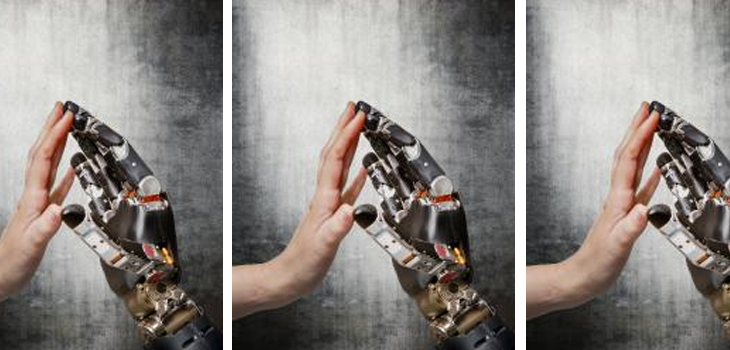
New research at the University of Chicago is laying the groundwork for touch-sensitive prosthetic limbs that one day could convey real-time sensory information to amputees via a direct interface with the brain.
Touch-Sensitive Prosthetic Limbs: Progress!
2 min read Premium comments
Secondary
“To restore sensory motor function of an arm, you not only have to replace the motor signals that the brain sends to the arm to move it around, but you also have to replace the sensory signals that the arm sends back to the brain, ” said the study’s senior author, Sliman Bensmaia, Ph.D., assistant professor in the Department of Organismal Biology and Anatomy at the University of Chicago, in the October 14, 2013 news release. “We think the key is to invoke what we know about how the brain of the intact organism processes sensory information, and then try to reproduce these patterns of neural activity through stimulation of the brain.”
Bensmaia’s research is part of Revolutionizing Prosthetics, a multi-year Defense Advanced Research Projects Agency (DARPA) project that seeks to create a modular, artificial upper limb that will restore natural motor control and sensation in amputees. Managed by the Johns Hopkins University Applied Physics Laboratory, the project has brought together an interdisciplinary team of experts from academic institutions, government agencies and private companies.
Bensmaia and his colleagues at the University of Chicago are working specifically on the sensory aspects of these limbs. Using monkeys, the researchers identified patterns of neural activity that occur during natural object manipulation and then successfully induced these patterns through artificial means. The first set of experiments focused on contact location, or sensing where the skin has been touched. The animals were trained to identify several patterns of physical contact with their fingers. Researchers then connected electrodes to areas of the brain corresponding to each finger and replaced physical touches with electrical stimuli delivered to the appropriate areas of the brain. The result was that the animals responded the same way to artificial stimulation as they did to physical contact.
When the researchers focused on the sensation of pressure they developed an algorithm to generate the appropriate amount of electrical current to elicit a sensation of pressure. Again, the animals’ response was the same whether the stimuli were felt through their fingers or through artificial means.
Finally, Bensmaia and his colleagues studied the sensation of contact events. When the hand first touches or releases an object, it produces a burst of activity in the brain. Again, the researchers established that these bursts of brain activity can be mimicked through electrical stimulation.
The result of these experiments is a set of instructions that can be incorporated into a robotic prosthetic arm to provide sensory feedback to the brain through a neural interface. Bensmaia believes such feedback will bring these devices closer to being tested in human clinical trials.
React:
Discussion
This is a fascinating development. In my practice we've seen similar outcomes with the revised protocol. The key differentiator seems to be patient selection criteria. Has anyone else noticed the correlation with BMI thresholds?
Great point. I'd push back slightly on the conclusion, the sample size in the cited study is too small to draw population-level inferences. That said, the directional signal is compelling and worth a larger RCT.
We implemented a similar approach last year. Early results are promising but we're still gathering 12-month follow-up data. Happy to share our protocol if anyone is interested.
Join the conversation
Orthopedic professionals are discussing this. Sign in and upgrade to read every comment and add your voice.