
As the team’s stay in Mbarara was coming to a close, the cases seemed to grow progressively more difficult. Then something wonderful happened. The team and its leader, Dr. Isador (Izzy) Lieberman pulled off what can only be described as a miracle—albeit one that came from training, experience and skill—but one that was still no less amazing and astonishing.
The Miracle of Surgery and Other Stories From the Uganda Spine Surgery Mission–Part III
7 min read Premium comments
(Excerpts from the team blog)
C Walks Again
Today’s first surgical patient doesn’t have a first name. At least, as far as his medical records at Mbarara are concerned, his first name is C.

" data-large-file="https://i0.wp.com/ryortho.com/wp-content/uploads/2013/10/TheMiracle_UgandaMission1_WEB.jpg?fit=350%2C217&ssl=1" src="https://i0.wp.com/ryortho.com/wp-content/uploads/2013/10/TheMiracle_UgandaMission1_WEB.jpg?resize=350%2C217&ssl=1" alt="" height="217" width="350">Courtesy: Uganda Spine Surgery Mission
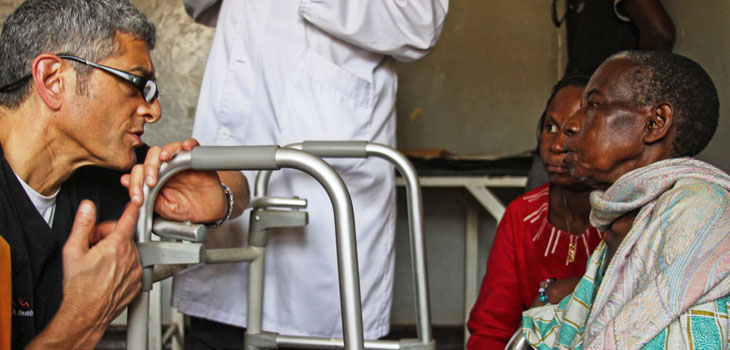
C is a sixty-five year-old man who is, for all intents and purposes, a wheelchair-bound quadriplegic. Degenerative changes in his cervical spine (the bones of his neck) have compressed and damaged the spinal cord at that level, leaving him with paralysis in his legs, a loss of bowel and bladder function, minimal function in his right hand and none in his left that has progressed over three months. Lying flaccid on the operating table awaiting his anesthetic, C asked me whether the operation would allow him to walk again. I passed the question on to Dr. Lieberman.
I was astonished to hear that indeed, Dr. Lieberman hoped the operation would accomplish just that.
Similar to Prudence’s operation, Dr. Lieberman approached C’s vertebral column through the side of his neck, navigating around some critical anatomy. He handed me a retractor he was using to push aside a vessel and asked, “What are you holding right now?” “The common 18 carotid, ” I replied, referring to the main artery carrying blood to the head. “Correct, ” he said, “if you slip, the patient will have a stroke.”
My hand cramped up a bit while standing there. Unlike most of the operations so far, C’s progressed without any surprises from our hosts (finally, no power outages!) and before we knew it his decompression (making more room for the spinal cord) and reconstruction (rebuilding and fusing the bones together) was complete.
Ida
Ida was not a new patient. Dr. Lieberman had operated on her cervical spine last year. She now returned with pain, weakness and tingling in her legs caused by spinal stenosis (when the spinal canal is narrowed and compresses the nerves in the cord). Last week, Ida had walked into our clinic slowly and with an unsteady gait, supported by her son who has since not left her side at the hospital for more than 20 minutes to stretch his legs. She wore a kind expression on her face, which along with her son’s iconic NY Yankees baseball cap, have made lasting impressions on us. Now, as Ida was assisted onto the surgical bed, I thought about her son who was undoubtedly pacing outside the double doors to the surgical wing, sporting his distinctive cap.

" data-large-file="https://i0.wp.com/ryortho.com/wp-content/uploads/2013/10/TheMiracle_UgandaMission2_WEB.jpg?fit=250%2C252&ssl=1" src="https://i0.wp.com/ryortho.com/wp-content/uploads/2013/10/TheMiracle_UgandaMission2_WEB.jpg?resize=250%2C252&ssl=1" alt="" height="252" width="250">Courtesy: Uganda Spine Surgery Mission
During Ida’s surgery, Dr. Lieberman carved out space around the compressed portions of the spinal cord and secured screws and rods in place to stabilize the spine. The highlight of my week came next, when Dr. Lieberman allowed me to secure a few screws and to help suture the incision. It’s a small thing for a surgeon, but as a medical student it was the first time I would leave my physical mark on a patient. The fact that it was kind-faced Ida who would carry the scars of those stitch marks made it even more meaningful.
The following day, I went to visit Ida and her son in the private surgical wards. Aside from a bit of pain, she was in great shape. As her son walked me out to the corridor, we chatted about their experience throughout his mother’s care. They had tolerated the crowded mini bus system over the 300 kilometer trip from Kampala to see us in Mbarara, only to find themselves completely disoriented and without instruction upon arrival at the hospital. Once admitted (to the private ward, no less), they had to provide their own food, bathing basin and other essentials. There were showers for those in the private ward, but no accommodations for a bed-ridden spine surgery patient.
After speaking with Ida’s son, it was clear to me that in Mbarara and perhaps Uganda at large, a patient must be his or her own advocate. Without a middle man to coordinate between patient and doctor, the patient’s own initiative determines the outcome of his or her care. In fact, when it was time for Ida’s surgery, no nurse came to retrieve her. Exasperated, her son walked his mother to the surgical ward and received her stretcher after the operation was complete.
The lesson of the day was embedded here: As part of the surgical team, I had a narrow view of our patient’s experience; as far as I knew, she had showed up to our clinic, arrived at the hospital for admission several days prior to surgery, and had made her way to the operating table just as was meant to be. But in between those encounters, Ida and her son had fought to get attention from uninterested nurses and administrators and had navigated a non-intuitive system in their efforts to seek optimal health care.
Quote of the day; “God lives right there” – Lieberman to Jennifer as she was retracting the carotid artery.
Scheurmann’s Disease

" data-large-file="https://i0.wp.com/ryortho.com/wp-content/uploads/2013/10/Miracle_Uganda4_WEB2.jpg?fit=683%2C1024&ssl=1" src="https://i0.wp.com/ryortho.com/wp-content/uploads/2013/10/Miracle_Uganda4_WEB2.jpg?resize=249%2C373&ssl=1" alt="" height="373" width="249">Courtesy: Uganda Spine Surgery Mission
Our next patient was a 14-year-old girl with a large thoracic kyphosis (an over-pronounced curve in her upper back). Her condition was consistent with Scheurmann’s disease, a pathology of abnormal bone growth causing wedge-shaped vertebra that exaggerate the normal thoracic kyphosis. With her deformity, the young girl found it painful to carry baskets of food on her head as is common practice here.
Dr. Lieberman’s plan was to straighten Catherine’s curve with metal rods anchored to the spine with vertebral screws. There were several power outages throughout the surgery, during which Dr. Lieberman could not use his ultrasonic bone cutter. Nevertheless, he adapted the procedure to the tools that he had until power returned. He would not be derailed by a simple power loss!
Our determination to get through the day unscathed met another challenge that afternoon. The autoclave (the machine that sterilizes our equipment between surgeries) failed during its cycle, leaving us with potentially still contaminated equipment for the operation.
Our next patient had two-level spinal stenosis and lay prepped and sleeping on the operating table while Dr. Lieberman, Rob and Sherri brainstormed alternatives. They decided to rerun the sterilization (a 45-minute cycle) while still proceeding with the operation using alternative tools. Rob scoured the hospital’s sterilized equipment room for substitutes while Sherri went through some of our own tool sets set aside for other procedures. With some creative ingenuity the decompression surgery (laminotomies and foraminotomies) got underway, and 60 minutes into the operation we received our freshly-sterilized equipment.
The Faculty Dinner Before Leaving
That evening, the hospital and university invited us to a buffet dinner at the Agip Motel. Those in attendance included the surgical team from the hospital, the university and hospital accountants, and two of the vice deans from the Faculty of Medicine. After the meal, each of our hosts in turn spoke of their gratitude to Dr. Lieberman and his team. They expressed their hope that the continued presence of the mission would allow them to build competence and expertise in spine surgeries, ultimately establishing Mbarara as the pinnacle spine surgery center of East Africa. After a week of hard work in the operating room, the team was moved to see the appreciation and long-term vision of our host institution. After all, we weren’t simply there to operate on eleven patients and call it a week. The mission was established to provide spine care to the less fortunate and train those who serve these patients. As the saying goes, “Give a man a fish and he will eat for a day. Teach a man to fish and he will eat for a lifetime.”

" data-large-file="https://i0.wp.com/ryortho.com/wp-content/uploads/2013/10/Miracle_Uganda1_WEB2.jpg?fit=730%2C423&ssl=1" src="https://i0.wp.com/ryortho.com/wp-content/uploads/2013/10/Miracle_Uganda1_WEB2.jpg?resize=730%2C423&ssl=1" alt="" title="Uganda Spine Surgery Mission4" height="423" width="730">
- Courtesy: Uganda Spine Surgery Mission
After dinner, the team gathered in our hotel lobby and discussed the lessons of the day over a bottle of wine. Today taught us that surgery can be seen as a series of small failures that simply require some creativity and perseverance to overcome. Back home in the U.S. and Canada, the autoclave failure would have resulted in a canceled surgery. But here in Uganda, with limited time and even more limited resources, we could not afford to delay the operation.
Quote of the day; “robot shmobot” – Lieberman to team after placing screws the old school way.
Thanks to the Sponsors
These remarkable team members could not have treated as many patients as they did without the generous support of the following people and companies.
Society Sponsors: Health Volunteers Overseas (Orthopaedic Overseas)
Corporate Sponsors: Globus Medical; J&J DePuy Synthes Spine; Misonix
Philanthropic Sponsors: MedWish International; AmeriCares; Ve’ahavta Organization
Team:
Isador Lieberman M.D. – Orthopedic Surgeon
Zvi Gorlick M.D. – Primary Care Physician
Sherri LaCivita – Surgical Technician
Robert Davis – Equipment Technician: Synthes Spine
Danielle Lieberman – Chef, Photographer, Scribe
Jennifer Teichman – Medical Student
Locations: Mbarara Regional Referral Hospital
Local Physicians:
Dr. Deo Bitariho (Department of Orthopaedics – Mbarara)
Dr. Emanuel Munyarugyero (Department of Anaesthesia – Mbarara)
React:
Discussion
This is a fascinating development. In my practice we've seen similar outcomes with the revised protocol. The key differentiator seems to be patient selection criteria. Has anyone else noticed the correlation with BMI thresholds?
Great point. I'd push back slightly on the conclusion, the sample size in the cited study is too small to draw population-level inferences. That said, the directional signal is compelling and worth a larger RCT.
We implemented a similar approach last year. Early results are promising but we're still gathering 12-month follow-up data. Happy to share our protocol if anyone is interested.
Join the conversation
Orthopedic professionals are discussing this. Sign in and upgrade to read every comment and add your voice.