
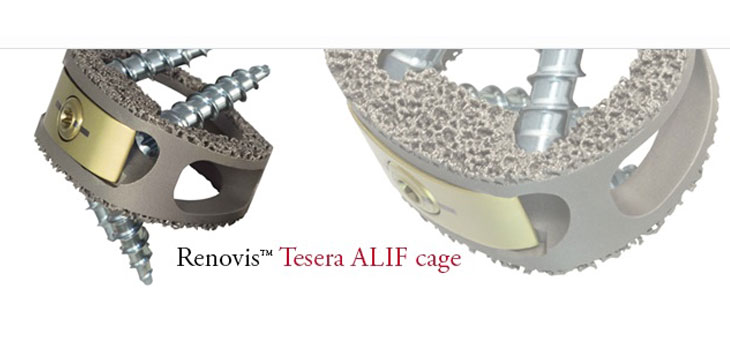
The FDA has granted 510(k) clearance to Renovis Surgical Technologies, Inc.’s porous titanium spinal implant. Called the Tesera Stand-alone ALIF Cage, the device uses additive manufacturing to create porous surfaces that, the company affirms, aid with bone in-growth from the vertebral endplates. The Tesera ALIF implant is the first in a family of spinal and orthopedic implants from Renovis to feature this platform technology.
Renovis Surgical Launches Spinal Implant
1 min read Premium comments
Secondary
Company officials explain that the Tesera ALIF cage begins as a titanium alloy powder, which is melted by electron beam into a solid structure, layer by layer, transitioning into a porous structure at the surfaces. The implant is one piece, rather than multiple pieces bonded together. Officials claim that this device is the first stand-alone anterior spinal cage to feature a true porous structure, rather than a spray-on coating or surface etching.
Renovis introduced the Tesera ALIF cage at this year’s North American Spine Society meeting in New Orleans. The company was founded in 2009 and is located in Redlands, California with manufacturing in Austin, Texas.
Author
React:
Discussion
This is a fascinating development. In my practice we've seen similar outcomes with the revised protocol. The key differentiator seems to be patient selection criteria. Has anyone else noticed the correlation with BMI thresholds?
Great point. I'd push back slightly on the conclusion, the sample size in the cited study is too small to draw population-level inferences. That said, the directional signal is compelling and worth a larger RCT.
We implemented a similar approach last year. Early results are promising but we're still gathering 12-month follow-up data. Happy to share our protocol if anyone is interested.
Join the conversation
Orthopedic professionals are discussing this. Sign in and upgrade to read every comment and add your voice.