
Putting soft cushioning in running shoes to prevent injuries may be a great marketing tool, but it does not prevent injuries. That is the result of a test with nearly 250 runners running in identical-looking shoes with different levels of cushioning in a blind trial. Factors such as body weight and fitness made a difference in injury rates of the runners, but shoe-softness did not.
Oops! Soft Shoes Won’t Prevent Running Injuries
2 min read Premium comments
Secondary
Miriam Stix, writing for Reuters, quoted Daniel Theisen of the Sports Medicine Research Laboratory of the Department of Public Health in Luxembourg, as saying, “The results do not support the common argument from the running-shoe industry that runners with higher body mass should be recommended shoes with greater shock-absorption characteristics.” Theisen, a physical therapist with a Ph.D. in sports science and a runner himself, fully expected to see a difference.
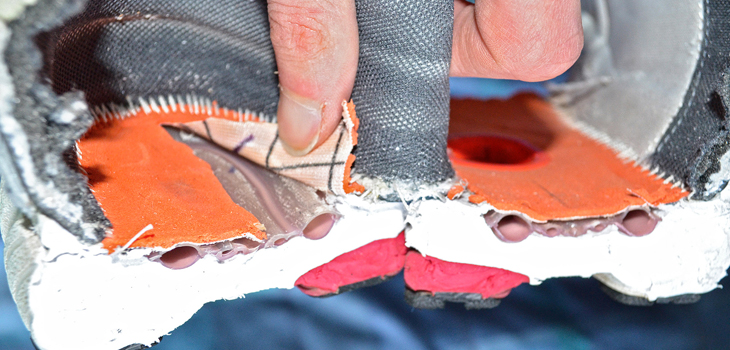
The researchers divided the 247 study participants into two groups. The participants were both men and women, were all between the ages of 30 and 50 years old, had body mass indexes ranging from normal to slightly overweight and all ran a minimum of 10 miles a week. Researchers gave the runners shoes that appeared to be identical except that half of the pairs had a soft midsole—a spongy layer beneath the insole of the shoe’s interior. The difference in shock-absorbing qualities between the shoes with and without the extra cushioning was calculated to be about 15%.
The runners were required to train at least once a week. Participants used the shoes for five months, and posted information about how much they ran and the kinds of injuries they experienced. Out of the 69 runners who had injuries, 32 used the hard-soled sneakers, and 37 used the softer-soled shoes. Heavier runners were about 13% more likely to have injuries than those in the normal weight range—and shoe softness did not modify that extra risk for heavy runners who got the softer shoes.
Mark P. Kelly, M.D., an exercise physiologist with the American Council on Exercise and a veteran runner, was not surprised by the findings. Cushioning “takes away from the tactile sensation that tends to protect a runner, ” Kelly said. “In other words, if something hurts our feet when we are jogging, we will naturally change things up so it doesn’t hurt. If anything, a harder midsole offers more protection, because it may induce more stability on the plantar surface of the foot and thus spread the impact out more evenly.”
Author
React:
Discussion
This is a fascinating development. In my practice we've seen similar outcomes with the revised protocol. The key differentiator seems to be patient selection criteria. Has anyone else noticed the correlation with BMI thresholds?
Great point. I'd push back slightly on the conclusion, the sample size in the cited study is too small to draw population-level inferences. That said, the directional signal is compelling and worth a larger RCT.
We implemented a similar approach last year. Early results are promising but we're still gathering 12-month follow-up data. Happy to share our protocol if anyone is interested.
Join the conversation
Orthopedic professionals are discussing this. Sign in and upgrade to read every comment and add your voice.