
PODs do not supply devices at a lower cost than other suppliers and may increase the cost of spinal surgery to Medicare over time.
OIG: PODs Don’t Save Money
2 min read Premium comments
Secondary
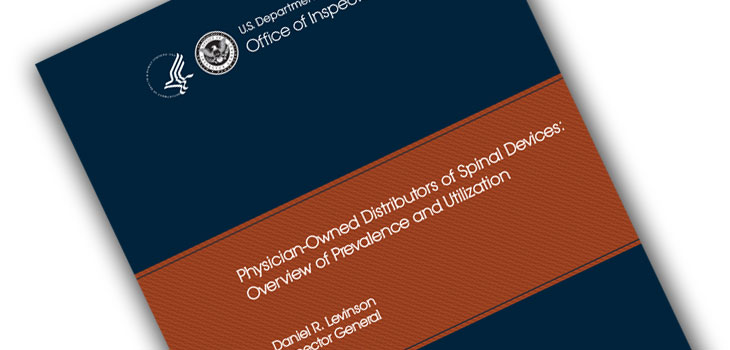
That’s the conclusion drawn by the long overdue report of the Office of Inspector General (OIG) requested by Congress last year on physician-owned distributorships.
The OIG concluded in the 31-page report released on October 24, 2013, that PODs are a substantial presence in the spinal device market. Said the report:
“Our findings raise questions about PODs’ claim that their devices cost less than those of other suppliers. Surgeons performed more spinal surgeries at hospitals that purchased from PODs, and those hospitals experienced increased rates of growth in the number of spinal surgeries performed in comparison to the rate for hospitals that did not purchase from PODs.
“Taken together, these factors may increase the cost of spinal surgery to Medicare over time. Finally, hospitals’ policies varied in whether they required physicians to disclose ownership interests in PODs to either the hospitals or their patients. Thus the ability of hospitals and patients to identify potential conflicts of interest among these providers is reduced.”
Medicare and Spine Surgery
In fiscal year 2012, Medicare paid hospitals a total of $3.9 billion for 178, 789 spinal surgeries. Medicare reimbursed hospitals an average of $21, 613 for each of these surgeries. On average, Medicare reimbursed hospitals $10, 289 for the least complicated spinal surgeries and $34, 676 for the most complicated surgeries, according to the report.
The OIG selected a sample of 1, 000 claims billed to Medicare in fiscal year 2011 that included spinal fusion surgery. They then asked each hospital associated with these claims to complete a questionnaire about its knowledge of physician ownership of spinal device suppliers. They also asked each hospital to complete a worksheet with details about the spinal devices used in each surgery in the sample.
In 2011, finds the report, PODs supplied devices used in nearly one in five spinal fusion surgeries billed to Medicare. Spinal surgeries that used POD devices used fewer devices but did not have lower per surgery device costs than surgeries that did not use POD devices. Among the hospitals in the sample, about a third reported buying spinal devices from PODs. When hospitals in the sample began buying from PODs, their rates of spinal surgery grew faster than the rate for hospitals overall.
Impact on Major Spine Manufacturers
Wells Fargo analyst Larry Biegelsen says the major spine players could benefit from a retrenchment in PODs. “We previously estimated that PODs have captured about 10-15% of the $5.7 billion U.S. spinal hardware market; however, the OIG report suggests that PODs may have captured almost 20%.
Although the impact of the OIG report is unclear at this time, Biegelsen estimates that if PODs went away completely, NuVasive, Inc., Globus Medical, Inc. and LDR would benefit the most among the major spine players with potentially 6-10% upside to their annual sales because they do not sell to PODs. “At the very least, the OIG report should curtail the growth of PODs, which would be good for the large spine players, in our view.”
Court Challenge
The POD debate has headed to court, as Reliance Medical Systems, LLC, has challenged the constitutional basis for OIG’s determination that legally doing business with PODs is “inherently suspect”?
To read the entire OIG report, click here.
Author
React:
Discussion
This is a fascinating development. In my practice we've seen similar outcomes with the revised protocol. The key differentiator seems to be patient selection criteria. Has anyone else noticed the correlation with BMI thresholds?
Great point. I'd push back slightly on the conclusion, the sample size in the cited study is too small to draw population-level inferences. That said, the directional signal is compelling and worth a larger RCT.
We implemented a similar approach last year. Early results are promising but we're still gathering 12-month follow-up data. Happy to share our protocol if anyone is interested.
Join the conversation
Orthopedic professionals are discussing this. Sign in and upgrade to read every comment and add your voice.