
Three orthopedic societies have recently announced a unique initiative, the Orthopaedic Resident Training Initiative (ORTI), which will develop, organize and fund three courses in hip and knee arthroplasty for medical residents. The participating societies include American Association of Hip and Knee Surgeons (AAHKS), The Hip Society, and The Knee Society. In addition to the founding societies for this collaboration, The International Congress on Joint Reconstruction (ICJR) will manage the organization and logistics coordination for the courses.
Innovative Hip/Knee Course Coming
2 min read Premium comments
Secondary
“Residency is a critical part of training our future orthopaedic surgeons, but there is more we can do to ensure they begin practicing with the best hands-on experience, ” said William P. Barrett, M.D. chair for the AAHKS Committee on Joint Education Ventures, in the October 11, 2013 news release.
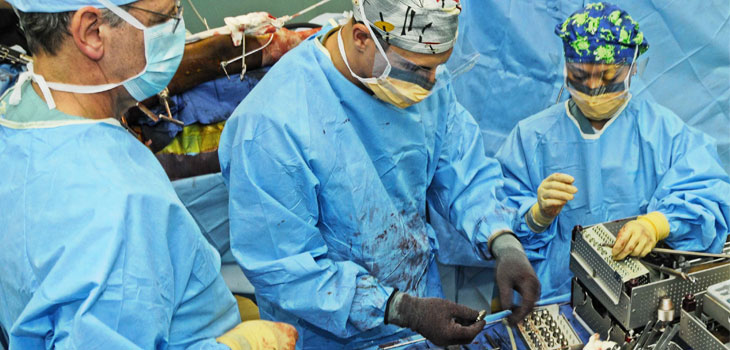
The ORTI will engage up to 250 second and third year residents during the spring of 2014 through three inaugural courses taking place in the greater Los Angeles, Atlanta, and Philadelphia areas. Participants will receive cadaveric training in hip and knee replacement procedures and the course curriculum will be developed and delivered by faculty who are members of The Hip Society, The Knee Society, and AAHKS.
“One of the core values of our organization focuses on active collaboration with other groups to help forward the practice of orthopaedics and to ultimately improve patient care, ” said Vincent D. Pellegrini, Jr., M.D., president of The Hip Society. “This is a great example of how we can work together to improve resident training.”
“The practice of orthopaedics is constantly changing, as new techniques and technologies become available. The ORTI will be another way to get residents trained and ready for improved patient care, ” said Steven J. MacDonald, M.D., FRCSC, president of The Knee Society.
“ICJR is changing the way training and education is delivered to surgeons, ” said W. Norman Scott, M.D., FACS, president, International Congress on Joint Reconstruction. “So this organization is uniquely positioned to do the same for the ORTI while seamlessly managing all of the logistics.”
The ORTI course curriculum is being developed with the goal of bringing together faculty with diverse, cutting edge experience with the latest advances in hip and knee replacement to educate orthopedic residents through interactive, hands-on sessions. The programs will provide a mix of didactic lectures, expert case study reviews, and hands-on cadaver labs allowing participants to reinforce their learning by working side-by-side with leaders in the field. The selection of the faculty and identification of course talks and workshops are truly a collaborative effort between the participating societies. All are committed to providing the most innovative program for future orthopedic surgeons.
William Barrett, M.D., chairman for the AAHKS Committee on Joint Education Ventures told OTW, “We are pleased to offer such an innovative approach to training future orthopaedic surgeons. Providing residents with an opportunity to work with a diverse group of faculty will enhance their training in ways we have not be able to do before.”
React:
Discussion
This is a fascinating development. In my practice we've seen similar outcomes with the revised protocol. The key differentiator seems to be patient selection criteria. Has anyone else noticed the correlation with BMI thresholds?
Great point. I'd push back slightly on the conclusion, the sample size in the cited study is too small to draw population-level inferences. That said, the directional signal is compelling and worth a larger RCT.
We implemented a similar approach last year. Early results are promising but we're still gathering 12-month follow-up data. Happy to share our protocol if anyone is interested.
Join the conversation
Orthopedic professionals are discussing this. Sign in and upgrade to read every comment and add your voice.