
On their first day at the Mbarara hospital, the team and its leader, Dr. Isador (Izzy) Lieberman, were confronted with power outages during surgery and inadequate anesthesia. The next day proved to be as remarkable and unpredictable as the first day. In situations like this, it’s really back to basics and each team member finds out what they’re made of.
Injured by a Goat (and Other Stories From the Uganda Spine Surgery Mission) PART II
7 min read Premium comments
(Excerpts from the team blog)
Why Would You Tie Yourself to a Goat?

" data-large-file="https://i0.wp.com/ryortho.com/wp-content/uploads/2013/10/Injured_UgandaMissionTrip1_WEB.jpg?fit=350%2C233&ssl=1" src="https://i0.wp.com/ryortho.com/wp-content/uploads/2013/10/Injured_UgandaMissionTrip1_WEB.jpg?resize=350%2C233&ssl=1" alt="" height="233" width="350">Courtesy: Ethical Sector Communications
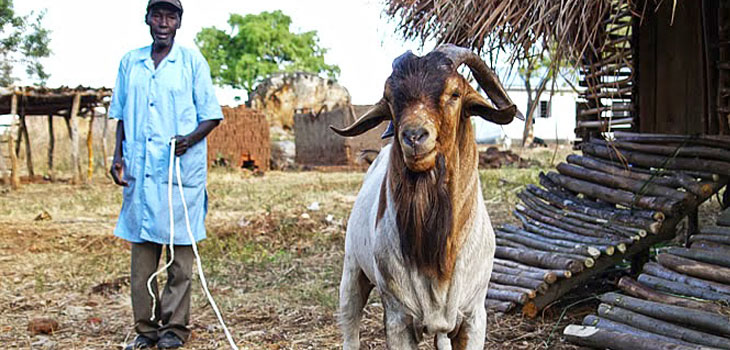
Sixty-seven patients later, we were done for the day. On the drive back to the hotel, we reflected on some of the cases from that day, including Bernadette, a 45-year-old woman who injured her back while pulling a goat tethered to her waist. One team member wondered aloud why anyone would tie themselves to a goat.
Quote of the day: “If you haven’t mutton-busted, you haven’t lived.” Rob’s response to the question “why would anyone tie themselves to a goat?”
Our first two surgeries were sobering examples of the importance of thinking on your feet. When things don’t go as planned, improvise. Teams of longstanding colleagues (like the Texas team) work like well-oiled machines. They anticipate each other’s moves, communicate effectively, share expectations and have standard procedures that help things move smoothly. Perhaps today’s anesthetic troubles were not from a lack of competence, but rather from miscommunication and incongruent standard practices.
Waiting Measured in Years, Not Weeks or Months
The first day at Mbarara was a long one for everyone, but most especially for the patients and their families. The patients sat for hours on a bench in a dark, hot, narrow hallway with minimal food and water. Many of them had traveled long distances to Mbarara just to be seen by Dr. Lieberman.

" data-large-file="https://i0.wp.com/ryortho.com/wp-content/uploads/2013/10/Injured_UgandaMissionTrip5_WEB.jpg?fit=730%2C466&ssl=1" src="https://i0.wp.com/ryortho.com/wp-content/uploads/2013/10/Injured_UgandaMissionTrip5_WEB.jpg?resize=730%2C466&ssl=1" alt="" height="466" width="730">Courtesy: Ethical Sector Communications
When the patients began to push their way into the small examining room, we explained sympathetically that we were moving as fast as we could. They would simply have to wait longer. I was astonished by their patience and resilience.
As the day dragged on we began to appreciate a specific luxury of North American medical care: the process of waiting. To Canadians like me and Zvi, waiting a month to see a specialist elicits a groan and some exasperated comment about “the drawbacks of universal healthcare.” Waiting over an hour in an air-conditioned waiting room with cushioned seats and a Starbucks in the lobby prompts a similar reaction. Many of these Ugandan patients had lived for over 20 years with back pain. We saw teenagers and 20-somethings with spine deformities that in North America would have been corrected within the first two decades of their lives. Here, “waiting” is measured in years rather than weeks or months.
The next morning almost felt routine.
Sherri and Rob immediately started setting up the operating room and went hunting for yesterday’s tools that we had sent for sterilization.
Izzy, Zvi, Dr. Deo and I went to visit our two surgical patients from the day before. The patient’s ward was in a much older, smaller building. It consisted of 8-10 private rooms which flanked a dim, narrow hallway which opened up on either end to two large common rooms. The perimeter of each large room was lined with cots draped in sheets of all patterns, colours and sizes, leaving a narrow isle down the centre. The colours were so distracting that one could easily miss the patients sprawled on the beds.

" data-large-file="https://i0.wp.com/ryortho.com/wp-content/uploads/2013/10/Injured_UgandaMissionTrip2_WEB.jpg?fit=300%2C450&ssl=1" src="https://i0.wp.com/ryortho.com/wp-content/uploads/2013/10/Injured_UgandaMissionTrip2_WEB.jpg?resize=300%2C450&ssl=1" alt="" height="450" width="300">Courtesy: Ethical Sector Communications
Entire families were camped out on mats between and underneath the cots. Children squat and eat from containers of food prepared at home and brought to the hospital. (The Mbarara hospital does not provide meals to admitted patients, save for malnourished children.) The cots and mats were many family’s surrogate homes.
The pathologies in the surgical ward are as diverse as the bed sheets: limb amputations from motor vehicle accidents and gangrene, bowel obstructions, tuberculosis, breast cancers, malnourishment and most disturbing, and young girls with severe burns after acid was thrown on their faces. The contrast between this dilapidated surgical ward and the pristine operating theaters of the new building was astonishing.
After a quick visit with Muhamoud, our patient from yesterday afternoon, we left the surgical ward for the ICU where Amina, our first patient was recovering. We found Amina alert and sitting upright in her bed. Other than some pain around her surgical site, Amina was in fantastic shape. Our first patient, an 85-year-old woman who could barely walk a day before, would live out her remaining years with a greatly improved quality of life.
Flat-lined in the OR
Back in the operating room, the anesthesia team was prepping our first patient of the day.
Twenty-eight-year-old Naboth was a young man who had survived a motor vehicle accident only to develop post-traumatic kyphosis (a forward bend of the spine across the collapsed bone). His surgery began dramatically. After positioning young Naboth face down on the operating table, his monitor suddenly flat-lined. Acting quickly, we flipped him over and Dr. Emmanuel (the anesthesiologist) began chest compressions while a local nursing student and I began bagging (manually ventilating him with what looks like a whoopee cushion).

" data-large-file="https://i0.wp.com/ryortho.com/wp-content/uploads/2013/10/Injured_UgandaMissionTrip3_WEB.jpg?fit=730%2C451&ssl=1" src="https://i0.wp.com/ryortho.com/wp-content/uploads/2013/10/Injured_UgandaMissionTrip3_WEB.jpg?resize=730%2C451&ssl=1" alt="" height="451" width="730">Courtesy: Ethical Sector Communications
Then we found the problem. The canister that removes Naboth’s expired carbon dioxide from his breathing gases was leaking because someone had overfilled it with soda lime beads. This meant that while Naboth was effectively blowing off carbon dioxide, he wasn’t getting any oxygen in return. To make matters worse, Naboth’s pulse oximeter (the device that measures his oxygen saturation) had been disturbed when he was flipped onto his belly, which meant the team could not effectively monitor his oxygen saturation (amount of oxygen in his blood).
It took a few tense moments to figure all of this out and to restore Naboth’s breathing and proper ventilation. We continued with the operation as planned.
While the OR settled down, the skies outside were getting ready to burst. Before Naboth’s surgery was completed a heavy thunderstorm began blowing sheets of rain down on the hospital (the first rain Mbarara has seen this dry season and therefore a cause for excitement amongst our Ugandan colleagues). Not surprisingly, Dr. Lieberman had to operate through multiple power outages all day long. Thankfully, the ventilator is on an emergency power generator. It was in the midst of this downpour that Dr. Lieberman, Danielle and I held our lunchtime clinic in the open-air corridor outside the operating wing.
Although punctuated by frequent power outages, the second surgery of the day went surprisingly smoothly. This was the second step for Muhamoud, our patient from the previous day. Where his first operation used an anterior (frontal) approach to carve out his necrotic bone tissue, today’s operation would use a posterior (from the back) approach to stabilize and straighten his spine with screws and rods.
The Children
For some patients, their long-awaited visit with Dr. Lieberman brought bittersweet news: they were candidates for surgery, but would have to wait even longer. Kenneth, a short 18-year-old with a pockmarked face and a big smile, was born with severe scoliosis and has developed restrictive lung disease as a result of his rigid spine. He walks stooped over to the right because his scoliosis forces his left shoulder upwards. Unable to work with his deformity, Kenneth was hoping that an operation would restore his physical mobility and give him “purpose, ” as he put it. But to treat Kenneth’s condition the spine surgery team would 11 need three weeks in Uganda, and we only have six operating days here. Dr. Lieberman explained to Kenneth that he would have to wait until next year when there is the possibility of a longer mission.

" data-large-file="https://i0.wp.com/ryortho.com/wp-content/uploads/2013/10/Injured_UgandaMissionTrip4_WEB.jpg?fit=730%2C463&ssl=1" src="https://i0.wp.com/ryortho.com/wp-content/uploads/2013/10/Injured_UgandaMissionTrip4_WEB.jpg?resize=730%2C463&ssl=1" alt="" height="463" width="730">Courtesy: Ethical Sector Communications
Prudence is a beautiful six-year-old girl who’d been born with a cervical rib, an extra rib that sits on top of the first rib and can cause the patient considerable pain.
The surgical plan was to remove the articulation (where two bones meet) between the cervical and first ribs. Dr. Lieberman would approach the rib from the left side of Prudence’s neck, very close to some of the most critical nerves and vessels of the upper body. While the team prepped the operating room, I stood and chatted with our little patient. She loves to play football (American soccer) and to watch television cartoons. She used to have four siblings, but her little brother passed away last year at age one from a “hole in his heart.” She was a brave little girl, staring up at the ceiling from her gurney and concentrating hard on hiding any fears about the operation.
Shortly after the surgery began, Dr. Lieberman encountered his first challenge of the day: a branch of the brachial plexus, the meshwork of nerves that provide motor and sensory function to the upper limbs and trunk, traveled directly above the anomalous cervical rib. This would require meticulously careful dissection to avoid leaving Prudence with a neurological problem following surgery. Dr. Lieberman navigated his way around the nerve and the neighboring external jugular vein, found the cartilage and bone spicule of the articulation and resected without complication.
When I went to visit Prudence in the surgical wards that afternoon, she was awake, talking, and most importantly, able to wiggle the fingers of her left hand!
At dinner that night, the team discussed some of the mishaps over the last two days and discussed how “old school” is still very important. The ability to adapt to the situation and circumstances at hand, and revert to basic skills is critical to success.
Quote of the day; “it’s a good life!” Lieberman after seeing Amina on morning rounds
End of Part II
Next Week….A True Miracle in Mbarara
React:
Discussion
This is a fascinating development. In my practice we've seen similar outcomes with the revised protocol. The key differentiator seems to be patient selection criteria. Has anyone else noticed the correlation with BMI thresholds?
Great point. I'd push back slightly on the conclusion, the sample size in the cited study is too small to draw population-level inferences. That said, the directional signal is compelling and worth a larger RCT.
We implemented a similar approach last year. Early results are promising but we're still gathering 12-month follow-up data. Happy to share our protocol if anyone is interested.
Join the conversation
Orthopedic professionals are discussing this. Sign in and upgrade to read every comment and add your voice.