
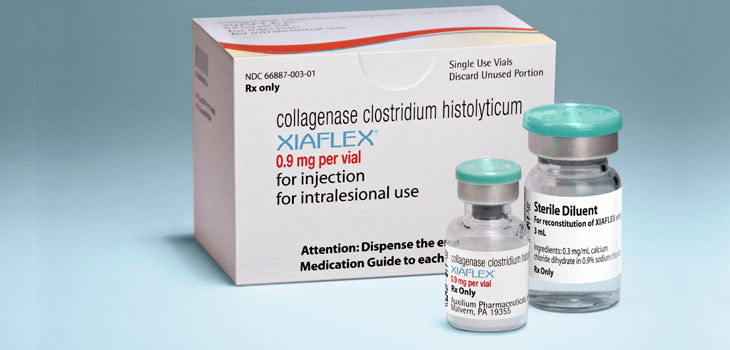
Auxilium Pharmaceuticals, Inc. has announced results from Year 4 of the Collagenase Optimal Reduction of Dupuytren’s – Long-term Evaluation of Success Study (“CORDLESS”). These data indicated that the overall recurrence rate at Year 4 was 42.1% for patients previously treated successfully with XIAFLEX for Dupuytren’s contracture. The study assessed 623 joints in adult Dupuytren’s patients with a palpable cord from earlier Auxilium studies, indicating that 57.9% of patients previously successfully treated with XIAFLEX did not experience disease recurrence based on the study’s definition.
Auxilium: Positive Results for XIAFLEX
2 min read Premium comments
Secondary
In the CORDLESS study, recurrence was defined as a 20 degree change of contracture with a palpable cord or when the treated joint underwent medical/surgical intervention. Of the 623 joints that were successfully treated with XIAFLEX, only 12.8% of those joints received medical or surgical intervention through Year 4. Of the joints that received medical or surgical intervention by Year 4 of the study, patients were most commonly retreated with XIAFLEX.
“As a doctor who frequently treats patients with Dupuytren’s contracture, I am encouraged by the recurrence rates seen among patients treated with XIAFLEX, a non-surgical therapy, ” said Clayton A. Peimer, M.D., Clinical Professor of Surgery, Michigan State University Medical School/ Marquette General Healthcare. “These data represent an important piece of information physicians, patients and payers can consider when determining the most appropriate treatment option for their patients.”
Through four years of follow-up, the adverse event (AE) profile of Dupuytren’s contracture patients successfully treated with XIAFLEX revealed no new long-term AEs. Of the 86 serious AEs reported through four years of follow-up, only one was considered related to XIAFLEX (decrease in ring finger circumference due to Dupuytren’s contracture resolution).
Dr. Peimer told OTW, “My coauthors and I were gratified to learn that Dupuytren’s patients who were successfully treated with enzyme injection to correct deformity and restore function—rather than requiring surgery and extended therapy and disability—do as well or better in the longer term than those who had operations. The use of collagenase to treat this disease has also caused reexamination of the natural history of the diagnosis and those findings now allow our patients options and choices that have only been a dream of treating physicians for two centuries.”
Dr. Peimer added, “Our experience and these data—in addition to earlier published, peer-reviewed studies—show that collagenase is an effective and safe alternative for surgery for Dupuytren’s contracture; and it offers correction/improvement as durable as with an operation but without many of the surgical risks and extended disability. Scientifically, we know that both surgery and collagenase injection will correct Dupuytren’s contracture deformities; we know that neither will cure nor alter the long-term course of the disease. Realistically, why would we recommend surgery when we can offer patients the same benefits with an injection?”
React:
Discussion
This is a fascinating development. In my practice we've seen similar outcomes with the revised protocol. The key differentiator seems to be patient selection criteria. Has anyone else noticed the correlation with BMI thresholds?
Great point. I'd push back slightly on the conclusion, the sample size in the cited study is too small to draw population-level inferences. That said, the directional signal is compelling and worth a larger RCT.
We implemented a similar approach last year. Early results are promising but we're still gathering 12-month follow-up data. Happy to share our protocol if anyone is interested.
Join the conversation
Orthopedic professionals are discussing this. Sign in and upgrade to read every comment and add your voice.