
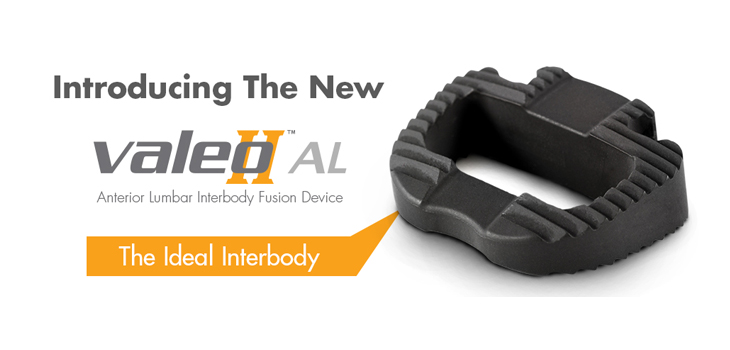
The names of devices grow longer and longer. Note Amedica Corporation’s new Valeo II Silicon Nitride Anterior Lumbar Interbody Fusion Device. The device is made from the firm’s silicon nitride biomaterial which, according to the company, has been shown to help promote bone growth and provide anti-infective properties. The device is indicated for intervertebral body fusion of the spine in skeletally mature patients and is designed for use with autograft to facilitate fusion.
Amedica Launches Valeo II
2 min read Premium comments
Secondary

Gary Powell, M.D., a civilian neurosurgeon at Elgin Regional Hospital, Elgin Air Force Base, Fort Walton, Florida, praises the surface on the re-engineered device. While the surface of the original device was textured to facilitate new bone growth, the new ones contain ridges that are placed in such a direction that they facilitate insertion into the interspaces in the lumbar spine but resist pulling out. “It really does work, ” Powell told OTW.
Powell praised Amedica’s diligence in gathering surgeon feedback on their revised product. “Before they put it on the market they brought it to a bunch of us and asked for our opinions. We were putting a lot of those devices in and wanted to help make them better, ” he said. There were about two years between the launching of the first and second modified product.
Powell is also impressed with the silicon nitride material out of which the devices are made. Unlike plastic or metal implants bone grows into it. “I can’t wait until I see coming down the pipe line artificial joints and other bodies made from this material. That could solve a lot of problems, ” he said.
Eric K. Olson, Amedica president and CEO said: “Amedica is committed to delivering products that address the changing needs of spinal surgeons. Our next generation Silicon Nitride AL device provides an optimal environment for bone growth while reducing the risk for infection due to its innate anti-infective properties. These benefits have the potential to improve the efficacy of spinal fusion procedures resulting in enhanced patient care. As Amedica continues to collaborate with surgeons to develop innovative, safe and effective interbody fusion devices, Silicon Nitride is increasingly becoming the gold standard material for spinal fusion devices.”
Author
React:
Discussion
This is a fascinating development. In my practice we've seen similar outcomes with the revised protocol. The key differentiator seems to be patient selection criteria. Has anyone else noticed the correlation with BMI thresholds?
Great point. I'd push back slightly on the conclusion, the sample size in the cited study is too small to draw population-level inferences. That said, the directional signal is compelling and worth a larger RCT.
We implemented a similar approach last year. Early results are promising but we're still gathering 12-month follow-up data. Happy to share our protocol if anyone is interested.
Join the conversation
Orthopedic professionals are discussing this. Sign in and upgrade to read every comment and add your voice.