
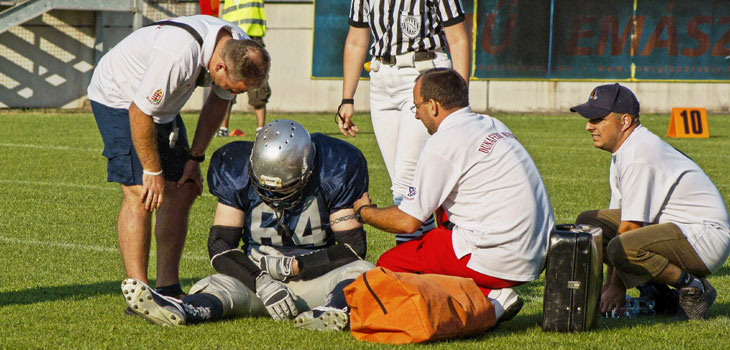
There is an app for almost everything. Now researchers at the University of Notre Dame have developed an app that, they believe, will diagnose concussions on the sidelines of football and other high impact games. As reported by Susan Young in Biomedicine News, studies have found that head injuries change speech characteristics, with noticeable effects on the production of vowels.
Voice Test Developed For Concussions
2 min read Premium comments
Secondary
What investigators wanted was a reliable side-line concussion test that could overcome the replies to coaches’ questions given by players who desperately want to stay in the game. Graduate student Hikhil Yadav designed a diagnostic tool that requires the person being tested to speak into a specially prepared recording device.
One of the first tests of the device was on 125 boxers taking part in a collegiate competition. Before the fights started the researchers recorded each athlete saying the numbers one through nine into the recording device to establish a baseline. After the boxing matches they recorded the athletes saying the same numbers again. By analyzing the sounds the app was able to identify all nine boxers who were later diagnosed with concussions.
“The preliminary results were very promising, ” Yadav says. The test wasn’t perfect, however, as it falsely identified concussions in three boxers. “That’s low in this early stage, but we don’t want to see false positives.”
The developers have since tweaked their model further.
The next step is a large test of the device with youth and high school football players. Investigators plan to test it on 1, 000 athletes between the ages of 10 and 18 in 20 different schools and clubs in Indiana, Illinois, Wisconsin, and Michigan. All predictions of concussions will be checked out with medical examinations.
Concussions remain a “highly under recognized injury, ” said Gerry Gioia, a pediatric neuropsychologist at Children’s National Medical Center in Washington, D.C.
According to Young, the Centers for Disease Control and Prevention estimates that as many as 3.8 million sports-related concussions occur in the U.S. each year. Because concussion can go undiagnosed, the true number of such injuries could be much higher. Few concussions are accompanied by loss of consciousness, and the variety of symptoms can be subtle and difficult to spot. Identifying a concussion can be critically important for athletes, since experiencing a single damaging blow to the head can put them at greater risk for another injury. Problems with memory and mental agility associated with concussion get worse with repeated blows to the head.
If the app proves its worth in the larger test, the researchers plan to turn it into a commercial product.
Author
React:
Discussion
This is a fascinating development. In my practice we've seen similar outcomes with the revised protocol. The key differentiator seems to be patient selection criteria. Has anyone else noticed the correlation with BMI thresholds?
Great point. I'd push back slightly on the conclusion, the sample size in the cited study is too small to draw population-level inferences. That said, the directional signal is compelling and worth a larger RCT.
We implemented a similar approach last year. Early results are promising but we're still gathering 12-month follow-up data. Happy to share our protocol if anyone is interested.
Join the conversation
Orthopedic professionals are discussing this. Sign in and upgrade to read every comment and add your voice.