
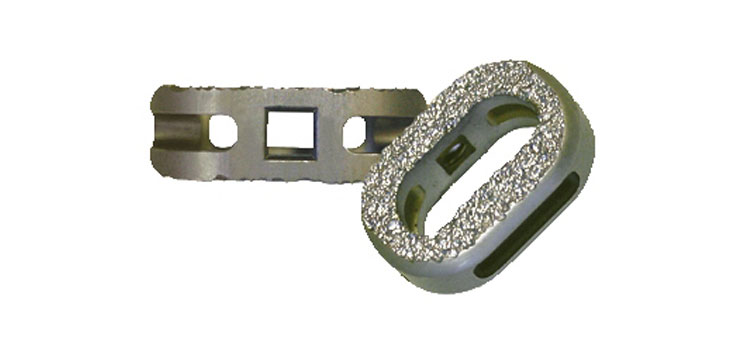
How the surface of an implant is textured makes a difference, according to a study currently available on The Spine Journal’s website and awaiting publication in an upcoming issue. The study, according to Titan Spine, LLC, demonstrates that the firm’s combination of textures provided by its implant surface technology promotes superior production of angiogenic growth factors as compared with PEEK (poly-ether-ether-ketone) and smooth titanium alloy materials.
Surface Texture Critical Component of Implants
1 min read Premium comments
Secondary
The study is titled “Rough titanium alloys regulate osteoblast production of angiogenic factors.” The project compared the production of osteogenic (bone formation) and angiogenic (blood vessel formation) growth factors by human osteoblast cells cultured both on PEEK, a smooth titanium alloy, and on Titan Spine’s roughened titanium alloy surface.
The lead author of the study, Barbara Boyan, Ph.D., Dean of the School of Engineering at Virginia Commonwealth University, said, “This experimental study demonstrates that the [Titan Spine surface] stimulates an angiogenic-osteogenic environment with factors important in bone formation and remodeling. This osteogenic environment may enhance bone formation, implant stability, and fusion.”
She added, “Our research shows that changes in implant surface structures at the micron and submicron levels have a significant impact on the bone formation response that is created. It is not enough to simply create a roughened texture at the macro level, as this has little to no effect on the behavior of an individual bone-forming cell. It is the structure of the surface at the micron and submicron levels that hold the key.”
Paul Slosar, M.D., medical director of Titan Spine expressed himself as being “very encouraged about the results of this study. Successful bony fusion will only take place in an environment where bone growth and vascularization can occur. Until now, research has been primarily focused on bone growth while angiogenic factors have been largely overlooked.”
Titan Spine is located in Mequon, Wisconsin and Laichingen, Germany and markets a full line of Endoskeleton interbody devices.
Author
React:
Discussion
This is a fascinating development. In my practice we've seen similar outcomes with the revised protocol. The key differentiator seems to be patient selection criteria. Has anyone else noticed the correlation with BMI thresholds?
Great point. I'd push back slightly on the conclusion, the sample size in the cited study is too small to draw population-level inferences. That said, the directional signal is compelling and worth a larger RCT.
We implemented a similar approach last year. Early results are promising but we're still gathering 12-month follow-up data. Happy to share our protocol if anyone is interested.
Join the conversation
Orthopedic professionals are discussing this. Sign in and upgrade to read every comment and add your voice.