
“The reasons to do a polyethylene insert exchange might include isolated liner wear, knee instability, or specific circumstances surrounding knee stiffness, ” argues Mark Pagnano. “Hold up, ” says Jerry Engh. “IF the original implant was a defective poly, and IF good poly is available for the exchange, then it is a reasonable option.”
Pagnano Takes On Engh Over Poly Insert Exchange
8 min read Premium comments
Great Debates
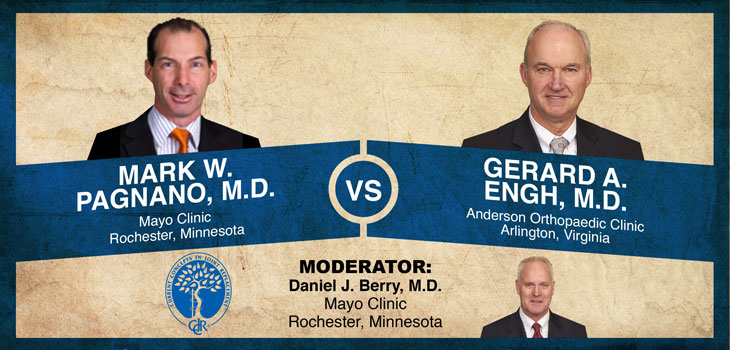
This week’s Orthopaedic Crossfire® debate is “Polyethylene Insert Exchange: Not the Chip Shot It Seems.” For the proposition is Mark W. Pagnano, M.D. of Mayo Clinic in Minnesota; against the proposition is Gerard A. Engh, M.D. from the Anderson Orthopaedic Clinic in Virginia. Moderating is Daniel J. Berry, M.D. from Mayo Clinic in Minnesota.
Dr. Pagnano: “While there is justified enthusiasm for the long term success of total knee arthroplasty [TKA], the polyethylene remains the weak link for many patients. We recognize that modular tibial trays were developed at least in part to allow surgeons to swap out or exchange the tibial poly in selected patients with malfunctioning TKA, particularly for problems due to wear.”
“The reasons to do polyethylene insert exchange might include isolated liner wear, knee instability, or specific circumstances surrounding knee stiffness. All of these isolated revisions typically require the presence of a well-aligned and well-fixed set of components.”
“There is limited data looking at whether this design concept has substantial merit. If we go back to 2000, Jerry Engh presented some good initial data, looking at 48 insert exchanges; 22 of those were done for wear and 26 were done for other reasons. Follow up at midterm suggested that seven of those knees failed within five years. Jerry’s conclusions from that study remain useful today: ‘Isolated polyethylene exchange should not be performed when there is accelerated wear of the insert…and you must consider multiple variables when contemplating limited revision.’”
“A 2006 study from Denmark included 27 late tibial poly exchanges; there was some emerging evidence that late exchanges might be a better group to look at. They looked at patients at a mean of nine years from the original knee; 20% failed at three years. In 2010 Cliff Colwell did a study on 42 knees; 30% were re-revised at three years and at ten years 50% were either revised or had pain. Cliff’s conclusion was: ‘Even with well-defined, narrow indications, isolated exchange should be done with caution.’”
“We at Mayo Clinic have done a number of studies on this, our purpose being to evaluate the effectiveness of isolated tibial exchange. From 1985-1997 we looked at 63 insert exchanges. A total of 24 were done for poly failure, seven for stiffness; the mean age was 66. Most of the exchanges were done relatively early, a mean of 4 years after surgery; some extended all the way to 12 years from the index arthroplasty. The follow up was substantial: from 2-14 years, with an average of 8 years.”
“The probability of implant survival for any reason was 64% at five years. We did not find a difference based on gender, age, BMI [body mass index], or the type of knee arthroplasty. There was a trend toward poorer outcomes in those insert exchanges that were done relatively early.”
“Patients with instability had about a 50% failure rate at three years; 33% failed for wear at a mean of four years. As for the patients revised for motion problems, it was an inconsistent operation where the gains in motion after an isolated insert exchange and removal of scar tissue were modest at best.”
“Jerry’s latest paper included 135 knees revised for wear. He looked at isolated exchange, single component revision, and full revision, with success rates at midterm being 82%, 89%, and 88%, respectively. There is a selection bias in this study that should be addressed. The poly exchanges should be the highest performers; there was no loosening and no substantial bone loss in that group. They should be the easiest revisions and should have the best outcomes. Interestingly, none of the full revision cases failed for wear or instability, and only one full revision failed before ten years.”
“So I think that for most failed TKAs in 2012 you should look for any reason to do a complete revision. If the knee is perfectly aligned, well-fixed, with an intact locking mechanism…and you can ensure that a new, high quality polyethylene is available, then you can consider polyethylene exchange.”
Dr. Engh: “I think we’d all agree that polyethylene insert exchange as an operative procedure really is a chip shot. It’s a very easy operation with low morbidity…and it’s a less expensive alternative than a full knee revision.”
“Unfortunately, there were two early articles condemning isolated insert exchange; I apologize for being the lead author on one of those. The other one came from Mayo Clinic. Ours had 48 isolated insert exchanges, 22 of which were for wear of the original insert. The time to insert exchange was 7.4 years. We had a 27% re-revision rate within five years. The problem was that the new inserts were also sterilized by gamma radiation in air, and we had no idea that shelf age was a problem.”
“The Mayo Clinic study involved 56 isolated exchanges, with a mean follow up of about 4.5 years; there was a 25% re-revision rate at only three years. The exchanges for wear did poorly, with a survivorship of only 71% at 5.5 years. Once again, those were revisions done mostly in the early 90s, a time when we didn’t know the shelf-age of the new poly; we didn’t even know any of the polys then.”
“I would argue, however, that isolated insert exchange was reasonable if the original implant was defective poly…and if good poly was available for the exchange. This was supported by Baker’s 2012 study where he had 45 poly exchanges with a mean follow up of about 58 months. Most revisions were for poly wear (76%); there was a 9% failure rate when he used gamma and inert poly. I would argue that replacing bad poly with good poly was a good idea.”
“In 2007 Bill Griffin did a study on 68 PFC (press-fit condylar) TKAs and found a 16% failure rate (mostly aseptic loosening); there was no progression of osteolysis in 97%. He still argued that this was a good operation. In our 2012 study, when we used gamma in air as the poly, our failure rate was 43%; when we used relatively good poly (gamma inert and non-gamma) we only had one failure.”
“A 2011 study by John Callaghan looked at liner exchange for wear and lysis with 25 knees…only one revised. So I would say that isolated insert exchange is not reasonable for an implant that has good poly, yet failed prematurely. This would indicate that you have a poor modular tibial locking mechanism, generating backside and topside wear. Or it would indicate that something was not done well in the beginning.”
“How do you decide? First of all, make sure the implant is stable and well-aligned, and that it has a satisfactory time to revision with reasonable poly. If it’s an old implant, verify the method of sterilization and the shelf-age. Then examine the failed implant. If you have delamination on the topside then you probably have irradiated poly—which is oxidized—and if you see protrusions/screw holes and wear on the backside of the implant, know that you cannot address that problem with a poly exchange.”
“In conclusion, an insert exchange is a simple, safe way to change bad poly to good. It does not correct an unstable knee or a bad tibial locking mechanism. I believe that you should not commit your patients to a complex revision and a potentially poor outcome if it’s not absolutely necessary.”
Moderator Berry: “Please go through with us the specific situations in which you think it’s reasonable for the audience to do an isolated poly exchange. Acute infection?”
Dr. Pagnano: “If there is an acute infection and there’s a modular knee in place you need to get at that undersurface of the poly to do a complete debridement. It’s not an advantage, it’s a necessity.”
Moderator Berry: “Jerry, acute infection?”
Dr. Engh: “Yes, if you get to it early.”
Moderator Berry: “So the person that presents with late polyethylene wear, well-fixed implants, not a lot of osteolysis, synovitis. Is there a role for poly exchange there if you have a good locking mechanism and a good piece of poly?”
Dr. Pagnano: “It’s trying to go through that list of ‘How many if’s’ so I think Jerry and I have the same philosophy, namely, if we can find a compelling reason to think about taking out the femur or tibia, then I’ll do that. I’ll do it if I have a brand new plastic that’s going to be great and a good locking mechanism, and the implants are well aligned and well fixed. In my practice that’s one or two patients per year.”
Moderator Berry: “What is the role of poly exchange in instability?”
Dr. Engh: “If the instability was poor surgical technique and ligament imbalance, rarely can you correct that with poly exchange.”
Moderator Berry: “Mark?”
Dr. Pagnano: “I think an isolated exchange for instability is a very unpredictable operation. The only circumstance where that’s applicable is when the patient has equal instability in flexion and extension so that you’re not compromising one to fix the other.”
Moderator Berry: “What if someone has a thick piece of poly and somebody could downsize the poly to try to get a looser flexion and extension gap? Is there a role for isolated poly exchange in that patient? Mark?”
Dr. Pagnano: “That’s typically a loser because it’s going to be pretty rare that the reason the knee got stiff initially was because the plastic was too thick. It’s very uncommon for someone to put in a 12 or 15 plastic just for fun. So taking that out and putting in a thinner one makes it easier to do a better debridement and remove scar tissue. At best I think you can expect a 20-35 degree increase in range of motion.”
Moderator Berry: “So if you’re going to operate on a knee for stiffness, Mark, you’re usually going to do more than just address scar adhesions and downsize the poly?”
Dr. Pagnano: “Correct.”
Moderator Berry: “Jerry, what about stiffness? Is there a role to take out the poly and do just a scar removal?”
Dr. Engh: “I’m not sure there’s any good operation for stiffness. Just removing the poly probably isn’t enough because you can’t get up in the back of the knee, so I usually will go for a full revision in that situation.”
Moderator Berry: “In your current practice, what percent of your knee revisions were isolated poly exchanges? Jerry?”
Dr. Engh: “It’s become unusual because we corrected the problem of bad poly that those of us with gray hair lived through in the 80s and 90s; since we went to good poly, non-irradiated poly or gamma inert poly, we’re seeing few cases where poly wear necessitates a revision.”
Moderator Berry: “Is that less than 5%?”
Dr. Engh: “Yes.”
Dr. Pagnano: “Definitely less than 5%…probably more like 1%.”
Moderator Berry: “Thank you both.”
Please visit www.CCJR.com to register for the 2013 CCJR Winter Meeting, December 11–14 in Orlando, Florida.

“You may now view CCJR meeting content on your mobile device on the CCJR MobileTM App. Please scan the QR code to download from iTunes.”
React:
Discussion
This is a fascinating development. In my practice we've seen similar outcomes with the revised protocol. The key differentiator seems to be patient selection criteria. Has anyone else noticed the correlation with BMI thresholds?
Great point. I'd push back slightly on the conclusion, the sample size in the cited study is too small to draw population-level inferences. That said, the directional signal is compelling and worth a larger RCT.
We implemented a similar approach last year. Early results are promising but we're still gathering 12-month follow-up data. Happy to share our protocol if anyone is interested.
Join the conversation
Orthopedic professionals are discussing this. Sign in and upgrade to read every comment and add your voice.