
MIS EQUAL to Open for Deformity Correction
New Study Says MIS Deformity Surgery EQUAL to Open Surgery! // Stem Cell Breakthrough for Segmental Bone Defects // Olympic M.D. Uncovers New Keys to Bone Health
7 min read Premium comments
A new study, led by Neel Anand, M.D., clinical professor of surgery and director of spine trauma at Cedars-Sinai Spine Center in Los Angeles, is giving hope to those with scoliosis. The research team has found that minimally invasive surgery (MIS) is effective for the long-term correction of spinal deformities, including adult scoliosis. Dr. Anand, whose work was just published in Spine, tells OTW,
“This is the first study documenting the long-term results of MIS techniques for spinal deformity. We compared the efficacy of MIS techniques over two to five years; we found that a combination of three novel MIS techniques provided correction of adult spinal deformity comparable to traditional (open) surgery. The good news is that with MIS there were significantly improved functional outcomes, excellent clinical and radiological improvement, faster recovery times, less blood loss, and lower complication rates.
My team and I started doing MIS correction of spinal deformities in 2003, utilizing a series of technologies and techniques. In 2008 we published our first paper on the technique and its feasibility and in 2010 the results at one to three years. It’s terrific to now have concrete data on this most important topic. Deformity correction is one of the biggest operations we do, and has the greatest morbidity; complication rates of open spinal adult deformity are approximately 40-60%.
The biggest advantage of this approach is that there is not much blood loss because it means that the patient is more likely to have an easier recovery and not wind up in ICU. With open surgery the blood loss is 2-3 liters; while with MIS it’s about 200cc. In addition, because the patient is not losing much blood they don’t have the associated complications such as DIC [disseminated intravascular coagulation], cardiac events, stroke and so on. The complication rate with MIS is almost half that of open surgery. There are limitations, however. This is not for all patients. If someone has had a previous spinal fusion and then develops a deformity and needs an osteotomy, then traditional open techniques may still be needed. But for those well selected patients who can undergo MIS correction techniques, effective long-term correction and results can be obtained with less complications than traditional open methods.”
Stem Cell Breakthrough for Segmental Defects
Researchers from Cedars-Sinai have received a $5.18 million grant from the California Institute for Regenerative Medicine (CIRM)to develop a novel approach to treat segmental bone defects—without grafting bone. The principal investigator, Dan Gazit, Ph.D., D.M.D., told OTW,
“This is truly a new idea, namely recruiting the stem cells from the injury site instead of using bone grafts or stem cells that have been cultured ex vivo, in the lab; you are using a reservoir of stem cells that already resides within the bone marrow. Our technology consists of two steps: first we recruit the stem cells to the bone fracture site…then we deliver a bone-forming gene into the recruited cells using a short ultrasound pulse that opens tiny pores in the cell membranes, thus allowing the DNA to enter.
We first worked with rodents, taking three years to figure out how to recruit a critical mass of resident stem cells. This was important because you can’t successfully treat an injured organ unless you have significant numbers of these cells at the site of tissue loss. If you don’t have enough stem cells, efficient regeneration cannot be achieved since the therapeutic gene you deliver using the ultrasound does not reach the right target. After recruitment we turn the stem cells into active cells that differentiate and start to regenerate bone.
I’m thrilled that for the last several years we have been receiving emails from all over the world asking about using stem cells in orthopedic situations that seem hopeless. Together with Dr. Hyun Bae, an orthopedic surgeon who is the co-Principal Investigator in this project, we hope to leverage the funding we received from CIRM and make this technology available for millions of patients worldwide. Our first goal, upon successful completion of the funded project, which will take three years, will be to embark on phase one clinical trials.”
Olympic M.D. Discovers Keys to Bone Health
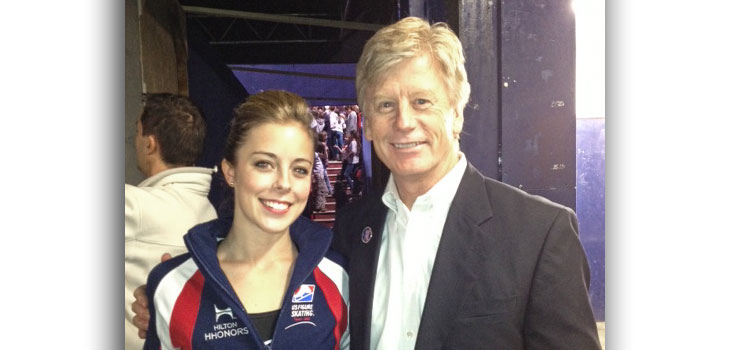
When the Olympic skaters hit the ice in Sochi, Russia, this coming February they will have undergone a week of preparatory medical “bootcamp.” That event, “Champs Camp, ” was just held at the Olympic Training Center in Colorado Springs, Colorado. Craig Westin, M.D. is one of the U.S. Figure Skating Team physicians, Medical Director of Chicago’s Joffrey Ballet, and orthopedic specialist with Illinois Bone & Joint Institute. Dr. Westin, who is one of two physicians designated by the U.S. Figure Skating Association for Sochi, tells OTW,
“All of the top U.S. skaters undergo a comprehensive review that includes their medical status and needs, including physical therapy and dietary. Their skating programs are also reviewed by U.S. judges including those who will be at the Olympics.
During the daytime the skaters perform their programs in a simulated competition environment. They also see sports psychologists, nutritionists, orthopedic surgeons, and primary care doctors. In the evenings the specialists from each field get together and discuss the data for each competitor, and how we can help optimize his or her health so they can perform their best.
The most interesting things I learned this week were the effects of metabolic and dietary status on performance. The skaters get dexascans to measure not only bone density but body composition (lean mass versus fat). They also have blood tests including iron levels, Vitamin D and cortisol stress hormone). In a sport like figure skating, being light and small is perceived as an advantage, but in fact, body weight is not the right thing to focus on. The important thing is to maximize muscle mass and minimize body fat. This is done by matching the caloric demands of the sport with caloric intake and the timing of that intake. If a skater burns 4, 000 calories a day, but is only taking in 3, 500 calories, then they are not meeting their caloric needs and the body perceives that as starvation. In relative starvation the body stores the calories as more fat and less muscle mass.
These skaters should have the strongest bones ever because of the physical loading of their bodies, but some are not optimizing their calcium and vitamin D metabolism. Skating is an indoor sport so these athletes are not exposed to a lot of sun. Many of them have adequate calcium intake, but in the absence sunshine, vitamin D does not become active. Without active D the calcium doesn’t get into the bones well. These kids are super athletes and if they have health problems it isn’t obvious by looking at them. Champs Camp is a superb opportunity to go over any and every issue that might get in the way of our Olympic athletes being at their best in Sochi.”
AAOS’ Remarkable Projects in Vietnam and China
“Sign your site” has made its way to Vietnam…the American Academy of Orthopaedic Surgeons (AAOS) comprehensive review course is coming to Argentina. Lynne Dowling, director of the International Department at AAOS, gives OTW an update on its projects around the globe.
“One of the most exciting things is that in the past six months the AAOS board of directors has renewed its interest in international work and has ‘greenlighted’ several new educational program concepts. Over the years the AAOS leadership has seen how the demand for participation in our annual meeting has escalated; they have also witnessed a significant increase in demand from the global orthopedic community for AAOS to come into countries and provide educational courses.
Our Vietnam efforts are going well; we have three programs in three cities where topics such as pediatric spine, adult reconstruction, and arthroscopy are taught. In this program, which is run in cooperation with the Vietnamese Orthopaedic Association, each program is rotated to a new location every three years. There are lectures, outpatient clinic visits, and live surgery with preselected patients; the U.S. faculty serve as mentors and consultants. Not only have we seen an improvement in surgical skills and care, but we are focusing on several patient safety measures including sign your site, preoperative time out, and the appropriate pre-op delivery of antibiotics. The Vietnamese medical personnel are making huge changes in these areas.
Next year, we will be starting a similar program, ‘Founding Principles in Orthopedics’ in three cities and provinces in China. We worked with the Chinese Orthopaedic Association (COA) to identify a broad variety of hospitals based on need, capacity, and size of the orthopedic department. Along with the COA president, Professor Yan Wang, we collaborated with each hospital and surveyed them using a tool developed by AAOS. This past May I traveled with a traumatologist to five sites; we did inspections, met with the leaders and staff, and then we reported back to the AAOS international committee. During the first quarter of 2014 our six U.S. faculty will spend a week working with the staff in China; then we will all meet back in the U.S. and design a customized program for each particular institution. U.S. faculty will not directly engage in live surgery until year three of the program. With China’s enormous patient population it is important to create especially tight guidelines about what they will and won’t treat. One reason we are taking our time is to give the Chinese personnel enough time to study English in depth, something they are very willing to do.
Lastly, we are partnering with the Argentine Orthopedic Association to create a new educational program. The program, which will launch in Buenos Aires in December 2014, will be available to all doctors in Latin America. This is a colleague-to-colleague initiative where we take the AAOS comprehensive board review course, work with and train 18 pre-selected Argentine faculty how to teach the 3.5 day program, and, with support from two U.S. faculty on-site in Argentina, conduct the comprehensive orthopedic review course, in Spanish, to Latin American orthopedic surgeons. A translated edition of the AAOS Comprehensive Orthopaedic Review books and question and answer book will be made available to all course participants. The course will be held annually in December for at least three years.”
React:
Discussion
This is a fascinating development. In my practice we've seen similar outcomes with the revised protocol. The key differentiator seems to be patient selection criteria. Has anyone else noticed the correlation with BMI thresholds?
Great point. I'd push back slightly on the conclusion, the sample size in the cited study is too small to draw population-level inferences. That said, the directional signal is compelling and worth a larger RCT.
We implemented a similar approach last year. Early results are promising but we're still gathering 12-month follow-up data. Happy to share our protocol if anyone is interested.
Join the conversation
Orthopedic professionals are discussing this. Sign in and upgrade to read every comment and add your voice.