
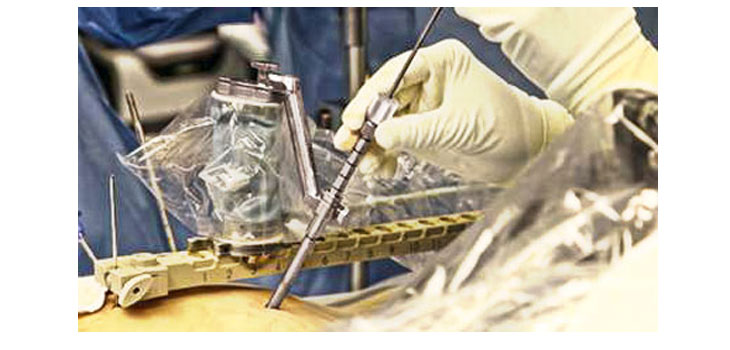
A patient at Celebration Health hospital, Orlando, Florida, was the world’s first to receive deep brain stimulation (DBS) using Mazor Robotics Renaissance Guidance System. Nizam Razack, M.D. performed the procedure in August and later performed a similar operation on two more patients with positive results.
Mazor Robotics Performs 1st Deep Brain Stimulation
1 min read Premium comments
Secondary
DBS is a procedure to implant a battery-operated medical device in the brain to deliver electrical stimulation to block abnormal nerve signals that cause the debilitating neurological symptoms of Parkinson’s disease and essential tremor.
The use of Renaissance’s proprietary pre-operative planning software allows surgeons to determine the optimal trajectory for implanting the electrodes before beginning the surgery and then use the guidance unit to execute the implantation with precision. In Razack’s three cases, he used Alpha Omega’s micro drive, NeuroDrive, in conjunction with Renaissance to carefully position the electrode in the appropriate area of the patients’ brains.
“Mazor Robotics Renaissance increases guidance accuracy during the procedure and adds an extra element of safety for patients undergoing this major operation, ” said Razack. “The technology also allows for less time in the operating room. I’ve performed over a thousand DBS procedures and I was eager to be a part of introducing this revolutionary technology into the neurosurgical field.”
Surgeons have successfully utilized Renaissance in 36 brain biopsy procedures in Germany. Mazor Robotics officials believe this could be a major application for Mazor Robotics technology as there are 180, 000 new diagnoses of brain tumors each year. In addition, according to the Parkinson’s Disease Foundation, more than 30, 000 patients with Parkinson’s have undergone DBS treatment and doctors diagnose 8, 000 to 10, 000 new cases worldwide each year.
Author
React:
Discussion
This is a fascinating development. In my practice we've seen similar outcomes with the revised protocol. The key differentiator seems to be patient selection criteria. Has anyone else noticed the correlation with BMI thresholds?
Great point. I'd push back slightly on the conclusion, the sample size in the cited study is too small to draw population-level inferences. That said, the directional signal is compelling and worth a larger RCT.
We implemented a similar approach last year. Early results are promising but we're still gathering 12-month follow-up data. Happy to share our protocol if anyone is interested.
Join the conversation
Orthopedic professionals are discussing this. Sign in and upgrade to read every comment and add your voice.