
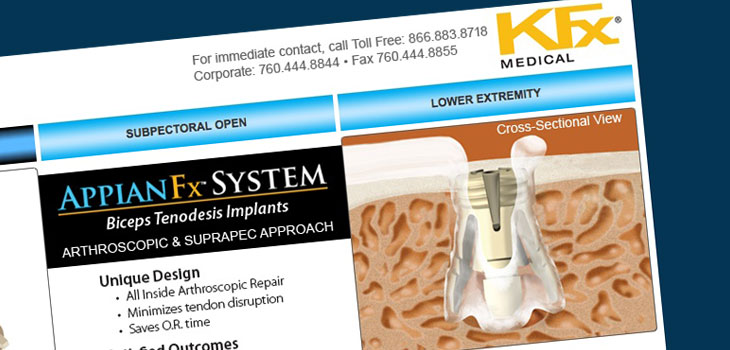
KFx Medical Corporation has announced that it has entered into a license agreement with Smith & Nephew relating to its patents used in knotless double row rotator cuff repair. According to the agreement, Smith & Nephew will have the right to promote the use of products and techniques for knotless double row rotator cuff repair.
License Agreement for KFx Medical, S&N
1 min read Premium comments
Secondary
“We are pleased to have reached an agreement with, and are proud to have our innovation recognized by Smith & Nephew. They are a global leader in the world’s orthopedic industry and share KFx’s dedication to helping improve people’s lives. I am pleased with the license arrangement and the prospect of seeing KFx’s valuable double row knotless rotator cuff technology reach even more patients, ” indicated Tate Scott, president and CEO, in the August 15, 2013 news release.
Joe Metzger, SVP, Marketing Services & Communications, Advanced Surgical Devices Division, Smith & Nephew, told OTW, “The license agreement will provide us with IP that we’ll incorporate as part of our sports medicine shoulder repair business. It’s too early to speak on product development and marketing plans.”
React:
Discussion
This is a fascinating development. In my practice we've seen similar outcomes with the revised protocol. The key differentiator seems to be patient selection criteria. Has anyone else noticed the correlation with BMI thresholds?
Great point. I'd push back slightly on the conclusion, the sample size in the cited study is too small to draw population-level inferences. That said, the directional signal is compelling and worth a larger RCT.
We implemented a similar approach last year. Early results are promising but we're still gathering 12-month follow-up data. Happy to share our protocol if anyone is interested.
Join the conversation
Orthopedic professionals are discussing this. Sign in and upgrade to read every comment and add your voice.