
OTW has previously described Integra LifeSciences Holdings Corporation’s development of a reverse shoulder system. Now the firm announces that William Geissler, M.D., professor of Orthopaedic Surgery at the University of Mississippi Medical Center, has performed the first implant of Integra’s new shoulder system.
Integra Implants First Reverse Shoulder
1 min read Premium comments
Secondary
“I was very pleased with the flexibility of the system’s platform stem, ” said Geissler. “The patient had two unsuccessful attempts at massive cuff repair and was in severe pain, with limited range of motion. During surgery, we found that the patient’s cuff tear was not repairable, which, combined with such severe arthritis, made her the perfect patient for reverse shoulder arthroplasty.”
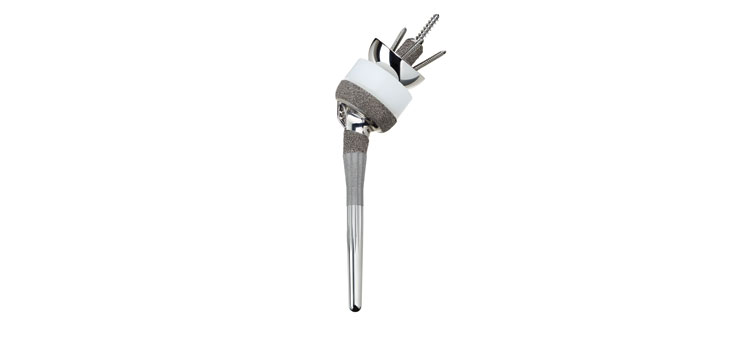
According to Integra LifeSciences officials, the Integra Titan Reverse Shoulder System is built on a unique platform stem that simplifies the conversion of a primary total shoulder, or hemi for fracture, to a reverse shoulder, without the need to remove a stem that is well-fixed in the patient’s bone. The system offers interchangeable components, which allow all primary, reverse, and fracture humeral bodies to be used with either the press-fit or cemented platform stems. They believe that this flexibility provides surgeons with minimally invasive intraoperative options, and the ability to offer continued care for the lifetime of the patient.
“The first implantation of our new Reverse Shoulder System is a great accomplishment, and we are very pleased with the outcome, ” said Robert Paltridge, corporate vice president and president for Extremity Reconstruction. “The system greatly expands our shoulder portfolio and offers surgeons additional options for patients who have exhausted other treatments.
Analysts estimate the global shoulder replacement market will reach approximately $865 million in 2014 and $1.3 billion by 2017. The addition of the Titan Reverse Shoulder System places Integra LifeSciences Holdings Corporation in a favorable position in this market.
Author
React:
Discussion
This is a fascinating development. In my practice we've seen similar outcomes with the revised protocol. The key differentiator seems to be patient selection criteria. Has anyone else noticed the correlation with BMI thresholds?
Great point. I'd push back slightly on the conclusion, the sample size in the cited study is too small to draw population-level inferences. That said, the directional signal is compelling and worth a larger RCT.
We implemented a similar approach last year. Early results are promising but we're still gathering 12-month follow-up data. Happy to share our protocol if anyone is interested.
Join the conversation
Orthopedic professionals are discussing this. Sign in and upgrade to read every comment and add your voice.