
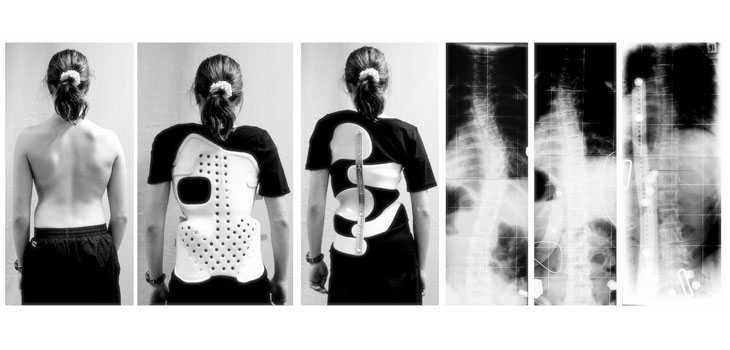
Wearing a back brace can be beneficial for patients with scoliosis, according to a study reported by Michael Smith, North American correspondent for MedPage Today. According to Smith, the success of the bracing was directly related to how long patients wore their braces on a daily basis. Those who wore them for six hours a day or less had a treatment success defined as 41%. Those who wore their braces for almost 13 hours a day had a success rate between 90% and 93%.
Got Scoliosis? Wear a Back Brace
1 min read Premium comments
Secondary
Researchers reported that in adolescent patients with idiopathic scoliosis, back braces decreased the progression of curves in some of their spines to the extent that surgery could be avoided.
Stuart Weinstein, M.D., University of Iowa, Iowa City and his colleagues reported online in the New England Journal of Medicine and at the annual meeting of the Scoliosis Research Society in Lyon, France that, in their prospective, partly randomized study, bracing led to treatment success in 72% of patients compared with 48% of those who did not receive bracing and were observed over time. Patients were between the ages of 10 and 15. The researchers stopped the multicenter study of 242 patients when the success of bracing became apparent.
Smith quoted William Taylor, M.D., University of California, San Diego, in La Jolla as saying that bracing is just one of the treatments available, and there is no specific marker that helps doctors and patients decide on which therapy to use, “Scoliosis comes as a range of diseases, of pathophysiology, and of treatments, ” he told Smith, adding that the study will “allow us to give patients and families higher-quality information.”
“I don’t know if it’s going to change practice, ” Taylor said, “but what it certainly does is change the discussion and change the information you have to give to patients about what some of the treatments are and also what some of the failures are.”
Author
React:
Discussion
This is a fascinating development. In my practice we've seen similar outcomes with the revised protocol. The key differentiator seems to be patient selection criteria. Has anyone else noticed the correlation with BMI thresholds?
Great point. I'd push back slightly on the conclusion, the sample size in the cited study is too small to draw population-level inferences. That said, the directional signal is compelling and worth a larger RCT.
We implemented a similar approach last year. Early results are promising but we're still gathering 12-month follow-up data. Happy to share our protocol if anyone is interested.
Join the conversation
Orthopedic professionals are discussing this. Sign in and upgrade to read every comment and add your voice.