
The FDA has given SpineGuard S.A. clearance to market three new spine products in the U.S.
FDA Clears SpineGuard Miniature Instruments
2 min read Premium comments
Secondary
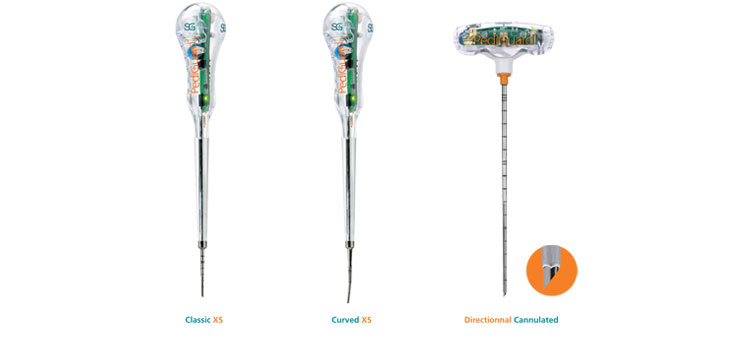
The company announced the clearances on August 28, 2013. The products complete the company’s PediGuard platform of single-use drilling instruments, which secure the pedicle screw pilot hole. The products are two miniaturized versions of the company’s classic and curved range, and a directional version of its cannulated series.
The company also announced on September 3, 2013, that it has received product certification (“Ninsho”) to market its classic and curved PediGuard products in Japan.
Pierre Jérôme, co-founder and CEO of the Paris and San Francisco-based company, said the U.S. clearance empowers the company to assist surgeons on the most challenging clinical situations and fortifies the potentially game-changing technology in the U.S. “The addition of a miniaturized PediGuard sensor opens the door to multiple new potential small-size applications of our platform, such as drill bits, guide wires or implants, ” added Stephane Bette, co-founder and CTO.
Pedicle Screw Placement Challenges
The company statement said that accuracy of pedicle screw placement remains a critical issue in spine surgery. They cited recently published papers studying screw placement accuracy, where the average rate of misplaced screws is approximately 20% (Tian 2011, Gelalis 2011, Verma 2010) with 2-7% of patients presenting neurologic complications (Amato 2010, Amiot 2000, Waschke 2012) and 4-5% of patients having vascular complications (Sarlak 2009, Samdani 2009, Belmont 2002) due to misplaced screws.
PediGuard
The PediGuard platform was co-invented by Maurice Bourlion, Ph.D., Ciaran Bolger, M.D., Ph.D., and Alain Vanquaethem, Biomedical Engineer. The company says the platform is the world’s first and only handheld device capable of alerting surgeons to potential pedicular or vertebral breaches. Real-time feedback is provided via audio and visual signals. Over 27, 000 procedures have been performed with PediGuard on all continents.
According to the company, several studies published in peer-reviewed medical and scientific journals have demonstrated that PediGuard detects 98% of pedicle breaches, presents an average screw placement accuracy of 97% (vs. 92% on average for navigation), provides 3-fold less pedicle perforations than with free-hand technique and a 3-fold reduction in neuro-monitoring alarms. It also, according to the company, limits radiation exposure by 25-30% and decreases by 15% the time for pedicle screw placement.
Jérôme and Bette, former executives at Medtronic Sofamor-Danek and SpineVision, co-founded SpineGuard in 2009.
Author
React:
Discussion
This is a fascinating development. In my practice we've seen similar outcomes with the revised protocol. The key differentiator seems to be patient selection criteria. Has anyone else noticed the correlation with BMI thresholds?
Great point. I'd push back slightly on the conclusion, the sample size in the cited study is too small to draw population-level inferences. That said, the directional signal is compelling and worth a larger RCT.
We implemented a similar approach last year. Early results are promising but we're still gathering 12-month follow-up data. Happy to share our protocol if anyone is interested.
Join the conversation
Orthopedic professionals are discussing this. Sign in and upgrade to read every comment and add your voice.