
Doctor Attacks Arthritis With Joint Distraction
Doctor Attacks Arthritis With Joint Distraction // Professor Creates New Arthroscopy Skills Simulator // More…
5 min read Premium comments
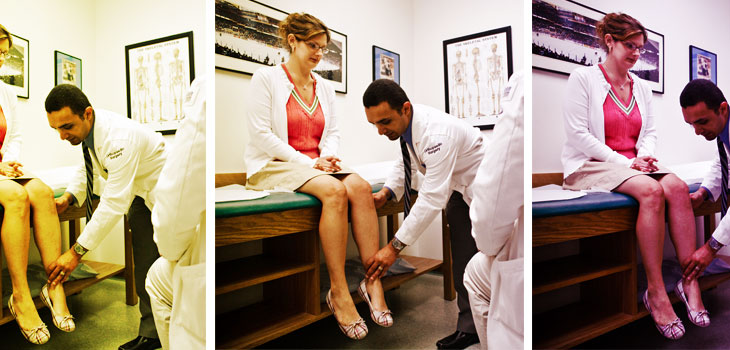
Sanjeev Sabharwal, M.D., M.P.H. is a pediatric orthopedic surgeon specializing in limb deformities. Dr. Sabharwal, president of the Limb Lengthening and Reconstruction Society (LLRS), tells OTW,
“We are seeing some reports of initial success with controlled joint distraction, primarily for early ankle arthritis in young adults, and certain cases of severe Perthes disease, affecting the femoral head in adolescents. The procedure, known as arthrodiatasis, may be indicated in certain younger patients with early arthritis or those at a high risk for developing premature arthritis who may not be ideal candidates for undergoing a fusion or joint arthroplasty.
The technique of arthrodiatasis involves placing an external fixator across the involved joint and distracting it a few millimeters to recreate a joint space. This procedure is mostly done using an articulated hinge so that the joint can still move while it is in the fixator (about three months). The treatment concept is based on unloading the arthritic joint by distraction while still allowing motion for joint lubrication and healing of the weight bearing areas. Thus far there are anecdotal reports indicating positive results in the short to medium term follow-up. We still need long term follow-up, as well as greater number of patients in order to further refine the indications for this procedure. It would be ideal to have multicenter comparative studies or analysis based on patient registries so that such emerging techniques can be more thoroughly investigated and compared with the more traditional treatment options. By having such pooled analysis one can perform a more in-depth analysis using robust methodology. Well done research studies in this field can help sort out which subgroup(s) of patients may be more likely to benefit from arthrodiatasis.”
Professor Creates New Arthroscopy Skills Simulator
Wouldn’t it be nice to know that the residents joining you in the OR for arthroscopy were properly trained? Now there is a way. Jonathan Braman, M.D. is an assistant professor in the Department of Orthopaedic Surgery at the University of Minnesota. He tells OTW,
“We have created an arthroscopic skills simulator that is different from any other on the market. We are not trying to simulate the inside of the joint with virtual reality. Instead, our simulator breaks down the skills needed to be a competent arthroscopist; and, the modules for those skills will be available in a low cost, self-directed way.
The modules, which are primarily geared toward PGY1 [post graduate year 1] interns, involve three main skills. The first is visualization, or the ability to see something on the screen and hold it. The second skill is triangulation or the manipulation of something in space. The third skill is object manipulation, or moving things around with your non camera hand.
We are now doing a pilot study where we are trying to demonstrate that the simulator can differentiate between expert arthroscopists and novices (construct validity). Then there is face validity where an expert arthroscopist says, ‘Yes, this is similar to what we do.’ In several weeks we will be embarking on a multicenter trial where learners are randomized into those who were exposed to the curriculum and those who were not. The three month study will involve benchmarks and will be similar to what is currently done with ‘open skills.’”
New Single Portal Arthroscopy Technique Announced
Daniel Cooper, M.D. is a sports medicine specialist at The Carrell Clinic in Dallas, Texas. Dr. Cooper, who is the developer of this new technique, told OTW,
“Forty years ago, in the early days of knee arthroscopy, surgeons were using a bulky device that didn’t allow them to visualize the pathology. Then modern arthroscopy was developed, which involved using a separate portal for the arthroscope and another portal for the working instrumentation. The following two decades we used three/four portal approaches; then in the early ‘90s industry developed the modern arthroscopy fluid pumps, which made management more efficient. This was very helpful to patients because most people who do lot of this recognize the morbidity involved in putting an extra cannula up through the quadriceps. Many studies—and my experience—show that eliminating the third portal helps patients recover quicker.
In 2008 I had an infected patient; one portal healed and the other drained, meaning that it needed to be washed out. I washed it out through just one portal by inserting both the arthroscope and shaver at the same time into the draining portal. This experience made me realize how much I could do and see, so I thought that if we could reduce the size of the instrumentation then we could get a lot done through the same sized portal. I approached Stryker Endoscopy executives with the concept of making a new instrumentation system for single portal arthroscopy. This was perfect timing in the industry due to recent improvements in fiberoptic and shaver design that allowed for a smaller arthroscope and instruments that could get the job done through a single portal and still retain excellent optics. The new instrumentation has just been released in the last two weeks.
We undertook a prospective study comparing 100 patients in a row who had a knee scope with two portal technique and 50 patients who underwent a single portal procedure. On average, the single portal patients reported improved activity scores and less pain at one month postop as compared to the two portal technique. Of those who underwent the single portal technique, 42 % never took a pain pill after discharge, a finding that was highly significant. We will soon be presenting all of our clinical results and have recently submitted this work for publication. I would like to note that this process was done in an extremely ethical manner; many products in orthopedics are brought to market after being used extensively (then someone reports on their experience retrospectively). Before we released this, however, we did a prospective study in the hands of the same surgeon.”
Danger: Don’t Wait to Treat Shoulder Instability
A veteran sports medicine doctor tells OTW,
“We really need to get the word out that shoulder instability in younger athletes must be treated early on. We are seeing more and more of these injuries and the old theory of, ‘We’ll just treat it later’ is not an option. Letting an unstable shoulder go on to multiple recurrences will have a negative effect on the athlete. Why? Because then they can’t have a simple operation to solve the problem.
Orthopedic surgeons must be more aggressive about early treatment of these injuries. I know of a case where a professional athlete’s shoulder popped out and he was told by the medical staff that he would be ‘fine.’ Once the scope went in, however, it was evident that the shoulder was blown apart. I am amazed that people are still debating this…it’s inappropriate because the data is the data. If you treat this injury conservatively the patients will have recurrences…and you will have done more damage in the long run.”
React:
Discussion
This is a fascinating development. In my practice we've seen similar outcomes with the revised protocol. The key differentiator seems to be patient selection criteria. Has anyone else noticed the correlation with BMI thresholds?
Great point. I'd push back slightly on the conclusion, the sample size in the cited study is too small to draw population-level inferences. That said, the directional signal is compelling and worth a larger RCT.
We implemented a similar approach last year. Early results are promising but we're still gathering 12-month follow-up data. Happy to share our protocol if anyone is interested.
Join the conversation
Orthopedic professionals are discussing this. Sign in and upgrade to read every comment and add your voice.