
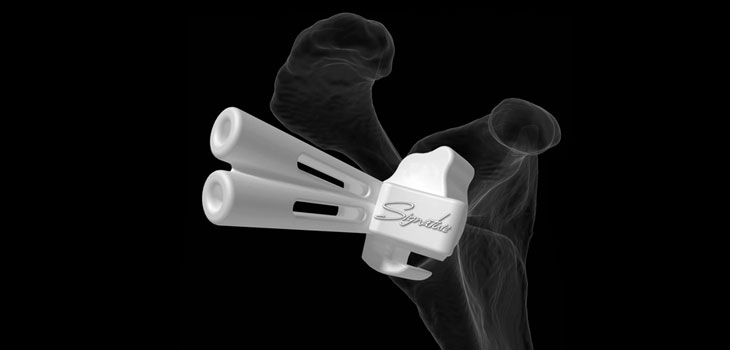
On September 4, 2013, Biomet Orthopedics, LLC, announced the first clinical use in the U.S. of the company’s Signature™ Patient-Specific glenoid instrumentation. The company says this is the only device of its type that features a patent-pending dual trajectory, allowing surgeons to elect a reverse or total shoulder procedure intraoperatively.
Biomet Claims First with Shoulder System
2 min read Premium comments
Secondary
The instrument’s glenoid guides utilize CT data and a proprietary algorithm to match each patient’s anatomy and facilitate proper positioning of the glenoid component. The announcement stated the preoperative planning tool “allows surgeons to make any necessary adjustments required for each patient, including component size, inclination, and version, prior to surgery.”
Shoulders, Hips and Knees
The system complements Biomet’s Access Instrumentation for its Comprehensive shoulder platform, which features patent-pending, four-step cannulated glenoid instrumentation and is the latest addition to company’s portfolio of patient-specific instrumentation technology.
The company’s Signature™ knee system has been used in over 80, 000 surgeries since its introduction in 2007. Biomet also recently introduced Signature™ instrumentation for acetabular positioning in total hip replacement.
Product Development Team
John Sperling, M.D., a participant in the product development of the system and an orthopedic surgeon in Rochester, Minnesota, said the system “is a major advance in shoulder arthroplasty. In addition to providing a time-efficient and user-friendly solution to consistently place the glenoid component”, Sperling said the system “provides the surgeon the ability to seamlessly choose between anatomic and reverse shoulder arthroplasty.”
Jason Hurst, M.D. another product development participant, said, “Given the inherent exposure and orientation challenges in total shoulder arthroplasty, this technology is ideally suited for the shoulder.” Hurst is an orthopedic surgeon with Joint Implant Surgeons in New Albany, Ohio. He added that the pre-operative plans were well replicated by the guides and very easy to use. “I believe that this tool provides me with reliable implant positioning.”
Simon Frostick, Professor of Orthopedics and surgeon at the Royal Liverpool University Hospital in Liverpool, U.K., said the combination of the Signature™ guide and the new Comprehensive Access cannulated instruments enables him to “position the glenoid component optimally and to implant the component with ease and speed.” Frostick was also a participant in product development of the system.
Author
React:
Discussion
This is a fascinating development. In my practice we've seen similar outcomes with the revised protocol. The key differentiator seems to be patient selection criteria. Has anyone else noticed the correlation with BMI thresholds?
Great point. I'd push back slightly on the conclusion, the sample size in the cited study is too small to draw population-level inferences. That said, the directional signal is compelling and worth a larger RCT.
We implemented a similar approach last year. Early results are promising but we're still gathering 12-month follow-up data. Happy to share our protocol if anyone is interested.
Join the conversation
Orthopedic professionals are discussing this. Sign in and upgrade to read every comment and add your voice.